

CTAL-TM_Syll2012 Exam Question 21
Test Management
Which one of the following metrics to be produced needs traceability between the test cases and each item in a proper test basis?
Which one of the following metrics to be produced needs traceability between the test cases and each item in a proper test basis?
CTAL-TM_Syll2012 Exam Question 22
Test Management
Which of the following statements best describes an appropriate approach for managing exploratory testing?
Number of correct responses: 1
K2 1 credit
Which of the following statements best describes an appropriate approach for managing exploratory testing?
Number of correct responses: 1
K2 1 credit
CTAL-TM_Syll2012 Exam Question 23
Consider the following skills assessment spreadsheet for your test team (consisting of four team members):
This spreadsheet has three sections: technical expertise, testing skills and professionalism.
The skill levels for each skill area for both the "technical expertise" and "testing skills" sections have been rated on a four-point scale:
-E (Expert): indicates that a person has expert knowledge and experience in the skill area
-B (Beginner): indicates that a person has some knowledge and experience in the skill area but he/she is not autonomous
-W (Wants to learn): indicates that a person has no knowledge or experience in the skill area but he/she wants to learn that skill
-NI (Not Interested): indicates that a person has no knowledge or experience in the skill area and he/she is not interested to learn that skill
The skill levels for each skill area of the "professionalism" section have been rated on a three point scale (H=High, M=Medium, L=Low).
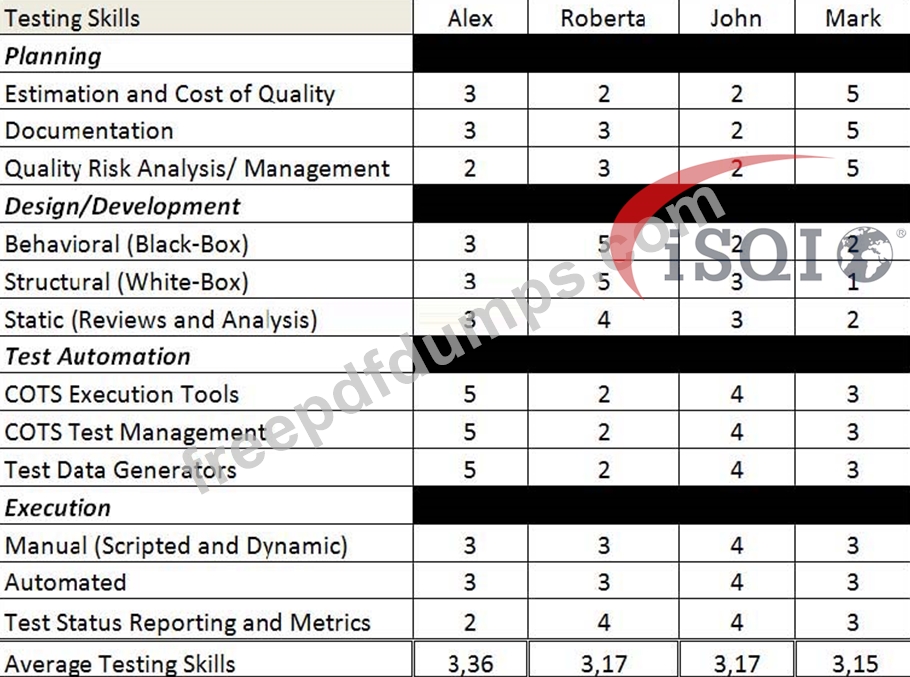
Consider the following analysis of testing skills performed on four peoplE. Alex, Robert, John and Mark (all the skills have been rated on an ascending scalE. The higher the score, the better the skill): Which of these people, based on this analysis, would you expect to be most suitable to work specifically as test designer?
K4 3 credits
This spreadsheet has three sections: technical expertise, testing skills and professionalism.
The skill levels for each skill area for both the "technical expertise" and "testing skills" sections have been rated on a four-point scale:
-E (Expert): indicates that a person has expert knowledge and experience in the skill area
-B (Beginner): indicates that a person has some knowledge and experience in the skill area but he/she is not autonomous
-W (Wants to learn): indicates that a person has no knowledge or experience in the skill area but he/she wants to learn that skill
-NI (Not Interested): indicates that a person has no knowledge or experience in the skill area and he/she is not interested to learn that skill
The skill levels for each skill area of the "professionalism" section have been rated on a three point scale (H=High, M=Medium, L=Low).
Consider the following analysis of testing skills performed on four peoplE. Alex, Robert, John and Mark (all the skills have been rated on an ascending scalE. The higher the score, the better the skill): Which of these people, based on this analysis, would you expect to be most suitable to work specifically as test designer?
K4 3 credits
CTAL-TM_Syll2012 Exam Question 24
Which of the following would you expect to be most likely an example of a demotivating factor for testers?
K2 1 credit
K2 1 credit
CTAL-TM_Syll2012 Exam Question 25
You are performing a quality risk analysis for a CSCI (Computer Software Configuration Item) used to implement a CBIT (Continuous Built-In Test) module of a safety-critical system.
During the quality risk analysis you are trying to identify the ways in which failures of the CBIT module can occur, for each of them trying to determine the potential causes and likely effects, and the risk level (calculated as the product of three factors: severity, occurrence and detection).
Which of the following risk analysis techniques are you working with?
K2 1 credit
During the quality risk analysis you are trying to identify the ways in which failures of the CBIT module can occur, for each of them trying to determine the potential causes and likely effects, and the risk level (calculated as the product of three factors: severity, occurrence and detection).
Which of the following risk analysis techniques are you working with?
K2 1 credit