

AZ-500 Exam Question 161
You have an Azure subscription that contains an Azure web app named 1 and a virtual machine named VM1. VM1 runs Microsoft SQL Server and is connected to a virtual network named VNet1. App1, VM1, and Vent are in the US Central Azure region.
You need to ensure that App1 can connect to VM1. The solution must minimize costs.
You need to ensure that App1 can connect to VM1. The solution must minimize costs.
AZ-500 Exam Question 162
You have an Azure subscription that contains the resources shown in the following table.

An IP address of 10.1.0.4 is assigned to VM5. VM5 does not have a public IP address.
VM5 has just in time (JIT) VM access configured as shown in the following exhibit.
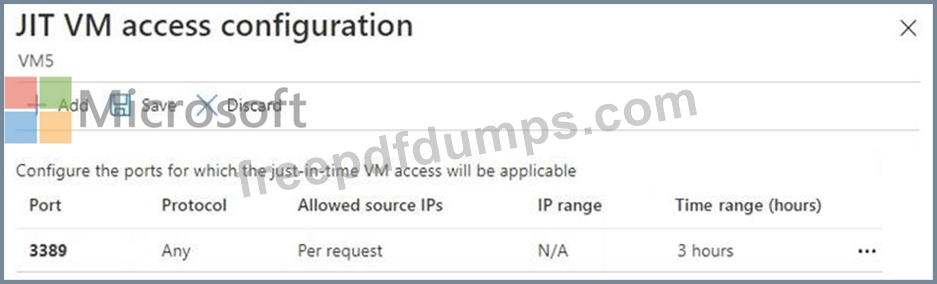
You enable JIT VM access for VM5.
NSG1 has the inbound rules shown in the following exhibit.
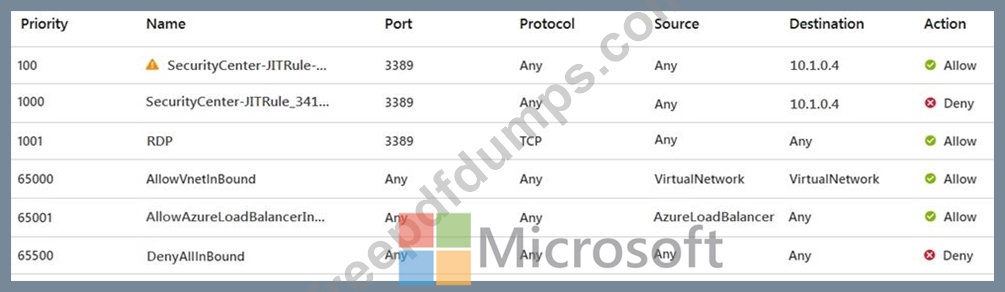
For each of the following statements, select Yes if the statement is true. Otherwise, select No.
NOTE: Each correct selection is worth one point.

An IP address of 10.1.0.4 is assigned to VM5. VM5 does not have a public IP address.
VM5 has just in time (JIT) VM access configured as shown in the following exhibit.
You enable JIT VM access for VM5.
NSG1 has the inbound rules shown in the following exhibit.
For each of the following statements, select Yes if the statement is true. Otherwise, select No.
NOTE: Each correct selection is worth one point.

AZ-500 Exam Question 163
Your company has two offices in Seattle and New York. Each office connects to the Internet by using a NAT device. The offices use the IP addresses shown in the following table.

The company has an Azure Active Directory (Azure AD) tenant named contoso.com. The tenant contains the users shown in the following table.

The MFA service settings are configured as shown in the exhibit. (Click the Exhibit tab.)

For each of the following statements, select Yes if the statement is true. Otherwise, select No.
NOTE: Each correct selection is worth one point.

The company has an Azure Active Directory (Azure AD) tenant named contoso.com. The tenant contains the users shown in the following table.
The MFA service settings are configured as shown in the exhibit. (Click the Exhibit tab.)
For each of the following statements, select Yes if the statement is true. Otherwise, select No.
NOTE: Each correct selection is worth one point.

AZ-500 Exam Question 164
You have an Azure Kubernetes Service (AKS) cluster that will connect to an Azure Container Registry.
You need to use automatically generated service principal for the AKS cluster to authenticate to the Azure Container Registry.
What should you create?
You need to use automatically generated service principal for the AKS cluster to authenticate to the Azure Container Registry.
What should you create?
AZ-500 Exam Question 165
You have an Azure subscription mat contains a resource group named RG1. RG1 contains a storage account named storage1.
You have two custom Azure rotes named Role1 and Role2 that are scoped to RG1.
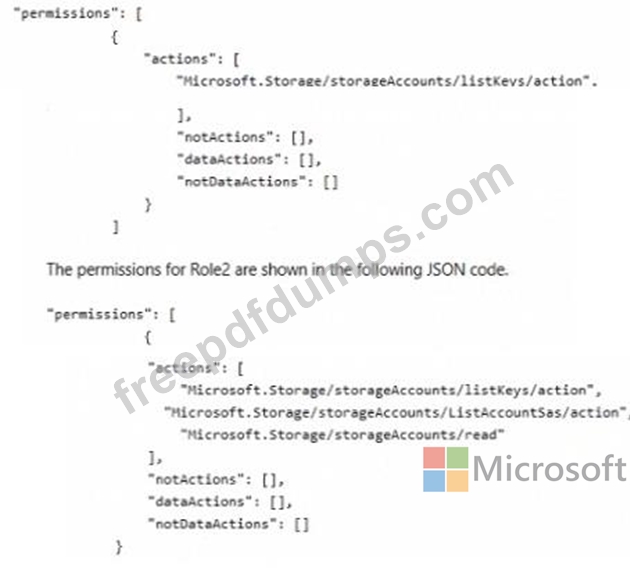
The permissions for Role1 are shown in the following JSON code.

You have two custom Azure rotes named Role1 and Role2 that are scoped to RG1.
The permissions for Role1 are shown in the following JSON code.
