

AZ-700 Exam Question 1
You have an Azure private DNS zone named contoso.com that is linked to the virtual networks shown in the following table.
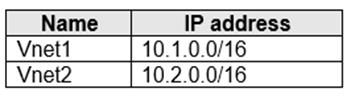
The links have auto registration enabled.
You create the virtual machines shown in the following table.
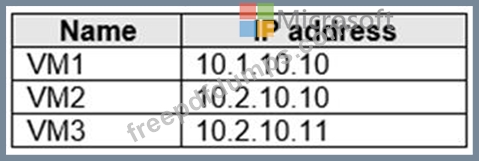
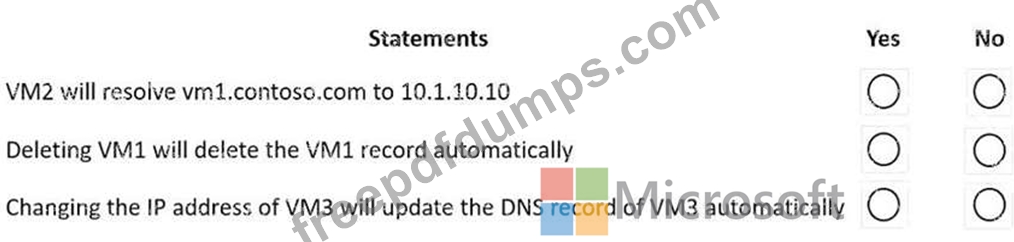
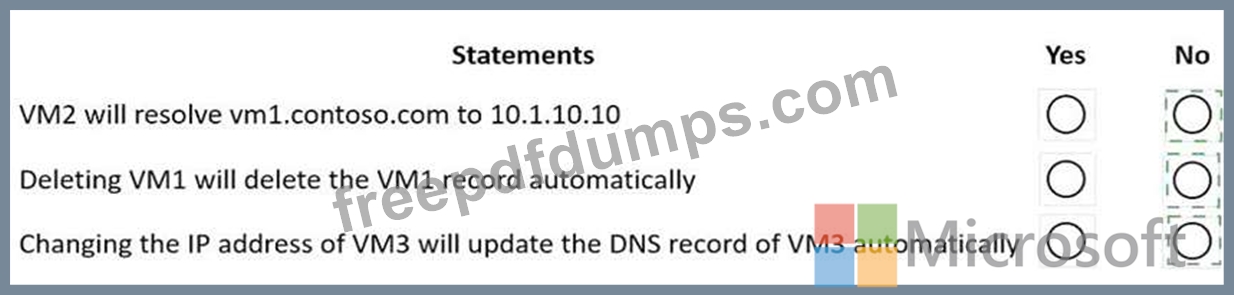
You manually add the following entry to the contoso.com zone:
* Name: VM1
* IP address: 10.1.10.9
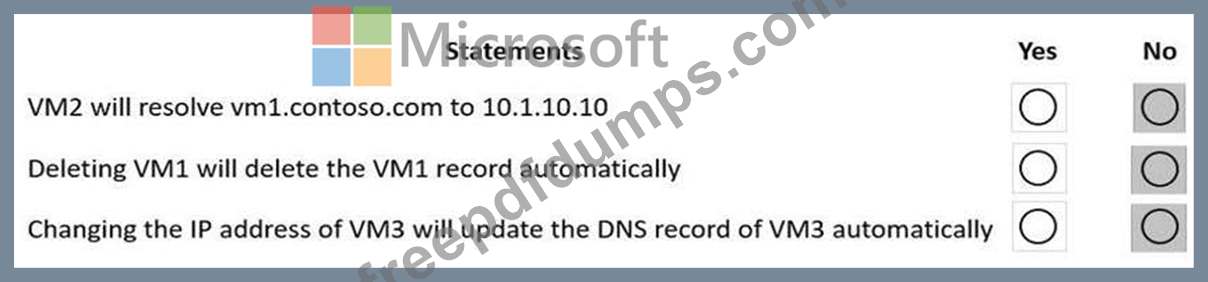
For each of the following statements, select Yes of the statement is true. Otherwise, select No.
NOTE: Each correct selection is worth one point.
The links have auto registration enabled.
You create the virtual machines shown in the following table.
You manually add the following entry to the contoso.com zone:
* Name: VM1
* IP address: 10.1.10.9
For each of the following statements, select Yes of the statement is true. Otherwise, select No.
NOTE: Each correct selection is worth one point.
AZ-700 Exam Question 2
Note: This question is part of a series of questions that present the same scenario. Each question in the series contains a unique solution that might meet the stated goals. Some question sets might have more than one correct solution, while others might not have a correct solution.
After you answer a question in this section, you will NOT be able to return to it. As a result, these questions will not appear in the review screen.
You have two Azure virtual networks named Vnet1 and Vnet2.
You have a Windows 10 device named Client1 that connects to Vnet1 by using a Point-to-Site (P2S) IKEv2 VPN.
You implement virtual network peering between Vnet1 and Vnet2. Vnet1 allows gateway transit. Vnet2 can use the remote gateway.
You discover that Client1 cannot communicate with Vnet2.
You need to ensure that Client1 can communicate with Vnet2.
Solution: You enable BGP on the gateway of Vnet1.
Does this meet the goal?
After you answer a question in this section, you will NOT be able to return to it. As a result, these questions will not appear in the review screen.
You have two Azure virtual networks named Vnet1 and Vnet2.
You have a Windows 10 device named Client1 that connects to Vnet1 by using a Point-to-Site (P2S) IKEv2 VPN.
You implement virtual network peering between Vnet1 and Vnet2. Vnet1 allows gateway transit. Vnet2 can use the remote gateway.
You discover that Client1 cannot communicate with Vnet2.
You need to ensure that Client1 can communicate with Vnet2.
Solution: You enable BGP on the gateway of Vnet1.
Does this meet the goal?
AZ-700 Exam Question 3
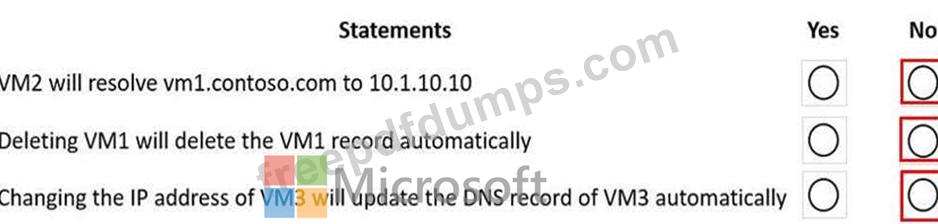
You have an Azure private DNS zone named contoso.com that is linked to the virtual networks shown in the following table.
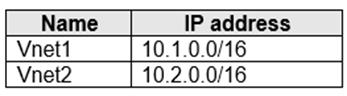
The links have auto registration enabled.
You create the virtual machines shown in the following table.
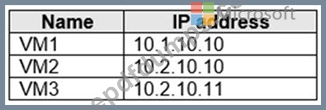
You manually add the following entry to the contoso.com zone:
Name: VM1
IP address: 10.1.10.9
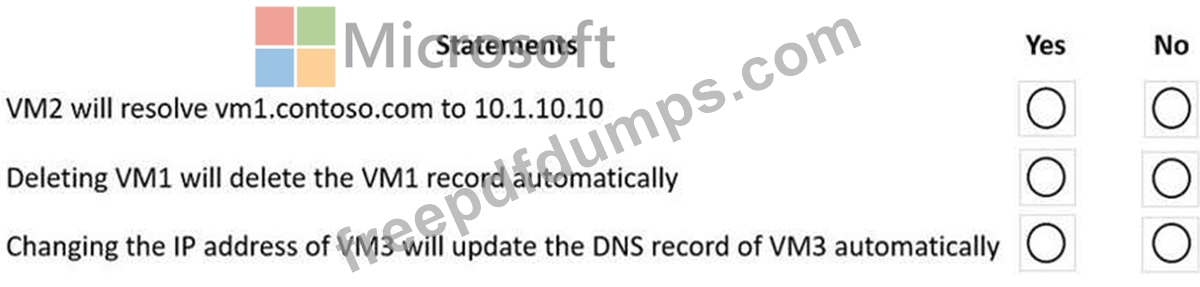
For each of the following statements, select Yes of the statement is true. Otherwise, select No.
NOTE: Each correct selection is worth one point.
The links have auto registration enabled.
You create the virtual machines shown in the following table.
You manually add the following entry to the contoso.com zone:
Name: VM1
IP address: 10.1.10.9
For each of the following statements, select Yes of the statement is true. Otherwise, select No.
NOTE: Each correct selection is worth one point.
AZ-700 Exam Question 4
Azure virtual networks in the East US Azure region as shown in the following table.

The virtual networks are peered to one another. Each virtual network contains four subnets.
You plan to deploy a virtual machine named VM1 that will inspect and route traffic between all the subnets on both the virtual networks.
What is the minimum number of IP addresses that you must assign to VM1?
The virtual networks are peered to one another. Each virtual network contains four subnets.
You plan to deploy a virtual machine named VM1 that will inspect and route traffic between all the subnets on both the virtual networks.
What is the minimum number of IP addresses that you must assign to VM1?
AZ-700 Exam Question 5
You have two Azure App Service instances that host the web apps shown the following table.

You deploy an Azure application gateway that has one public frontend IP address and two backend pools.
You need to publish all the web apps to the application gateway. Requests must be routed based on the HTTP host headers.
What is the minimum number of listeners and routing rules you should configure? To answer, select the appropriate options in the answer area.
NOTE: Each correct selection is worth one point.
You deploy an Azure application gateway that has one public frontend IP address and two backend pools.
You need to publish all the web apps to the application gateway. Requests must be routed based on the HTTP host headers.
What is the minimum number of listeners and routing rules you should configure? To answer, select the appropriate options in the answer area.
NOTE: Each correct selection is worth one point.
