

AZ-700 Exam Question 41
You have 10 Azure App Service instances. Each instance hosts the same web app. Each instance is in a different Azure region.
You need to configure Azure Traffic Manager to direct users to the instance that has the lowest latency.
Which routing method should you use?
You need to configure Azure Traffic Manager to direct users to the instance that has the lowest latency.
Which routing method should you use?
AZ-700 Exam Question 42
Note: This question is part of a series of questions that present the same scenario. Each question in the series contains a unique solution that might meet the stated goals. Some question sets might have more than one correct solution, while others might not have a correct solution.
After you answer a question in this section, you will NOT be able to return to it. As a result, these questions will not appear in the review screen.
You have an Azure subscription that contains an Azure Front Door Premium profile named AFD1 and an Azure Web Application Firewall (WAF) policy named WAF1. AFD1 is associated with WAF1.
You need to configure a rate limit for incoming requests to AFD1.
Solution: You configure a custom rule for WAF1.
Does this meet the goal?
After you answer a question in this section, you will NOT be able to return to it. As a result, these questions will not appear in the review screen.
You have an Azure subscription that contains an Azure Front Door Premium profile named AFD1 and an Azure Web Application Firewall (WAF) policy named WAF1. AFD1 is associated with WAF1.
You need to configure a rate limit for incoming requests to AFD1.
Solution: You configure a custom rule for WAF1.
Does this meet the goal?
AZ-700 Exam Question 43
Drag and Drop Question
You have two on-premises datacenters.
You have an Azure subscription that contains four virtual networks named VNet1, VNet2, VNet3, and VNet4.
You create an Azure virtual WAN named VWAN1. VWAN1 contains a single virtual hub that is connected to both on-premises datacenters and all the virtual networks in a full mesh topology.
You create a route table named RT1.
You need to configure VWAN1 to meet the following requirements:
- Connectivity between VNet1 and VNet2 and both on-premises datacenters must be allowed.
- Connectivity between VNet3 and VNet4 and both on-premises datacenters must be allowed.
- VNet1 and VNet2 must be isolated from VNet3 and VNet4.
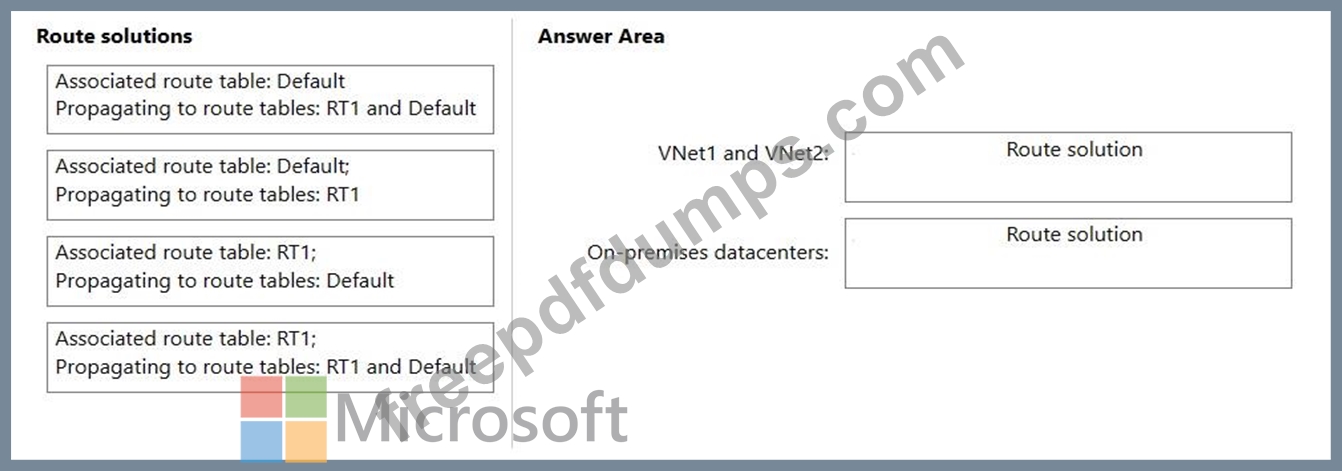
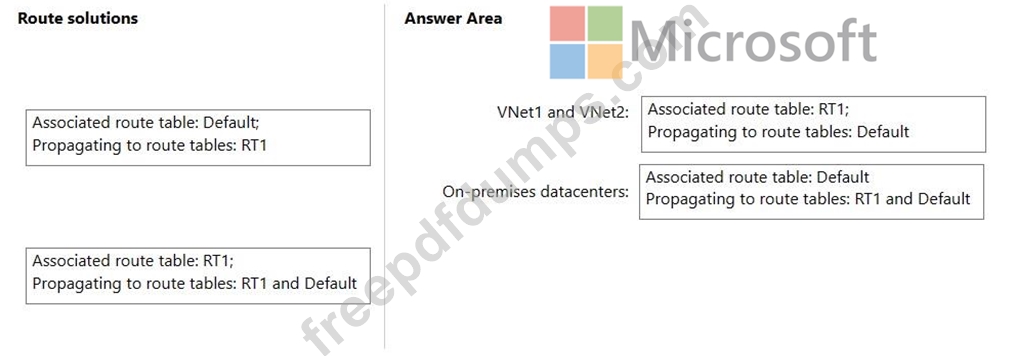
How should you configure routing for VNet1 and VNet2 and for both on-premises datacenters?
To answer, drag the appropriate route tables and route table propagation to the correct requirements. Each route table and route table propagation may be used once, more than once, or not at all. You may need to drag the split bar between panes or scroll to view content.
NOTE: Each correct selection is worth one point.
You have two on-premises datacenters.
You have an Azure subscription that contains four virtual networks named VNet1, VNet2, VNet3, and VNet4.
You create an Azure virtual WAN named VWAN1. VWAN1 contains a single virtual hub that is connected to both on-premises datacenters and all the virtual networks in a full mesh topology.
You create a route table named RT1.
You need to configure VWAN1 to meet the following requirements:
- Connectivity between VNet1 and VNet2 and both on-premises datacenters must be allowed.
- Connectivity between VNet3 and VNet4 and both on-premises datacenters must be allowed.
- VNet1 and VNet2 must be isolated from VNet3 and VNet4.
How should you configure routing for VNet1 and VNet2 and for both on-premises datacenters?
To answer, drag the appropriate route tables and route table propagation to the correct requirements. Each route table and route table propagation may be used once, more than once, or not at all. You may need to drag the split bar between panes or scroll to view content.
NOTE: Each correct selection is worth one point.
AZ-700 Exam Question 44
Hotspot Question
You have an Azure subscription that contains virtual networks, network security groups (NSGs), load balancer, virtual machines, and virtual network gateways.
You enable Azure Monitor Network Insights.
You need to perform the following actions:
- Review the NSG flow logs.
- Monitor resource utilization.
- Review the results of IP flow verify testing.
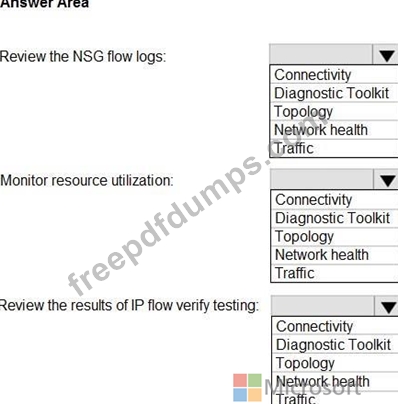
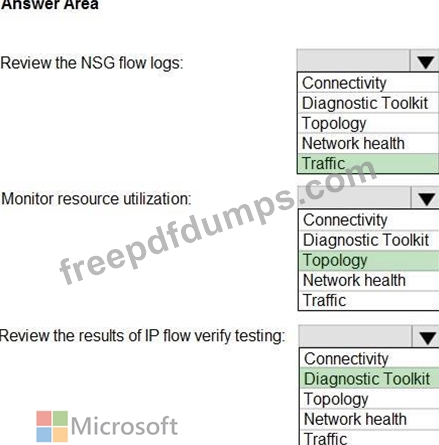
Which Azure Monitor Network Insights feature should you use for each action? To answer, select the appropriate options in the answer area.
NOTE: Each correct selection is worth one point.
You have an Azure subscription that contains virtual networks, network security groups (NSGs), load balancer, virtual machines, and virtual network gateways.
You enable Azure Monitor Network Insights.
You need to perform the following actions:
- Review the NSG flow logs.
- Monitor resource utilization.
- Review the results of IP flow verify testing.
Which Azure Monitor Network Insights feature should you use for each action? To answer, select the appropriate options in the answer area.
NOTE: Each correct selection is worth one point.
AZ-700 Exam Question 45
You have an Azure subscription that contains the resources shown in the following table.
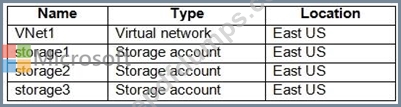
VNet1 contains a subnet named Subnet.
You need to ensure that the resources connected to Subnet1 can access only storage1 and storage3. The solution must minimize administrative effort.
What should you configure?
VNet1 contains a subnet named Subnet.
You need to ensure that the resources connected to Subnet1 can access only storage1 and storage3. The solution must minimize administrative effort.
What should you configure?