

AZ-700 Exam Question 141
Hotspot Question
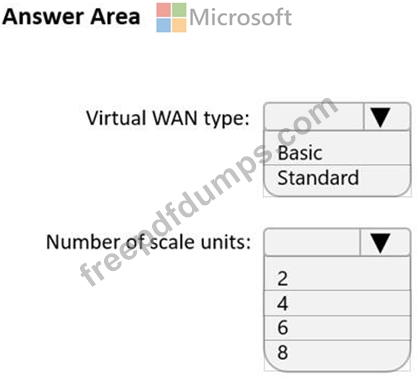
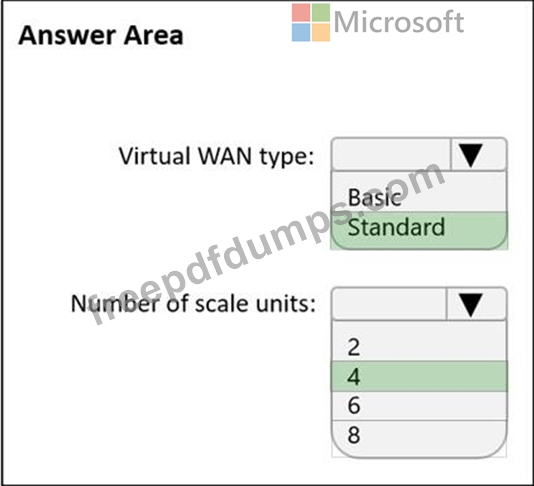
You plan to deploy Azure Virtual WAN.
You need to deploy a virtual WAN hub that meets the following requirements:
- Supports 10 sites that will connect to the virtual WAN hub by using a Site-to-Site VPN connection
- Supports 8 Gbps of ExpressRoute traffic
- Minimizes costs
What should you configure? To answer, select the appropriate options in the answer area.
NOTE: Each correct selection is worth one point.
You plan to deploy Azure Virtual WAN.
You need to deploy a virtual WAN hub that meets the following requirements:
- Supports 10 sites that will connect to the virtual WAN hub by using a Site-to-Site VPN connection
- Supports 8 Gbps of ExpressRoute traffic
- Minimizes costs
What should you configure? To answer, select the appropriate options in the answer area.
NOTE: Each correct selection is worth one point.
AZ-700 Exam Question 142
You have an Azure subscription that contains the public IPv4 addresses shown in the following table.

You plan to create a load balancer named LB1 that will have the following settings:
* Name: LB1
* Location: West US
* Type: Public
* SKU: Standard
Which public IPv4 addresses can be used by LB1?
You plan to create a load balancer named LB1 that will have the following settings:
* Name: LB1
* Location: West US
* Type: Public
* SKU: Standard
Which public IPv4 addresses can be used by LB1?
AZ-700 Exam Question 143
SIMULATION

Username and password
Use the following login credentials as needed:
- To enter your username, place your cursor in the Sign in box and click on the username below.
- To enter your password, place your cursor in the Enter password box and click on the password below.
- Azure Username: [email protected]
- Azure Password: xxxxxxxxxx
If the Azure portal does not load successfully in the browser, press CTRL-K to reload the portal in a new browser tab.
The following information is for technical support purposes only:
- Lab Instance: 12345678
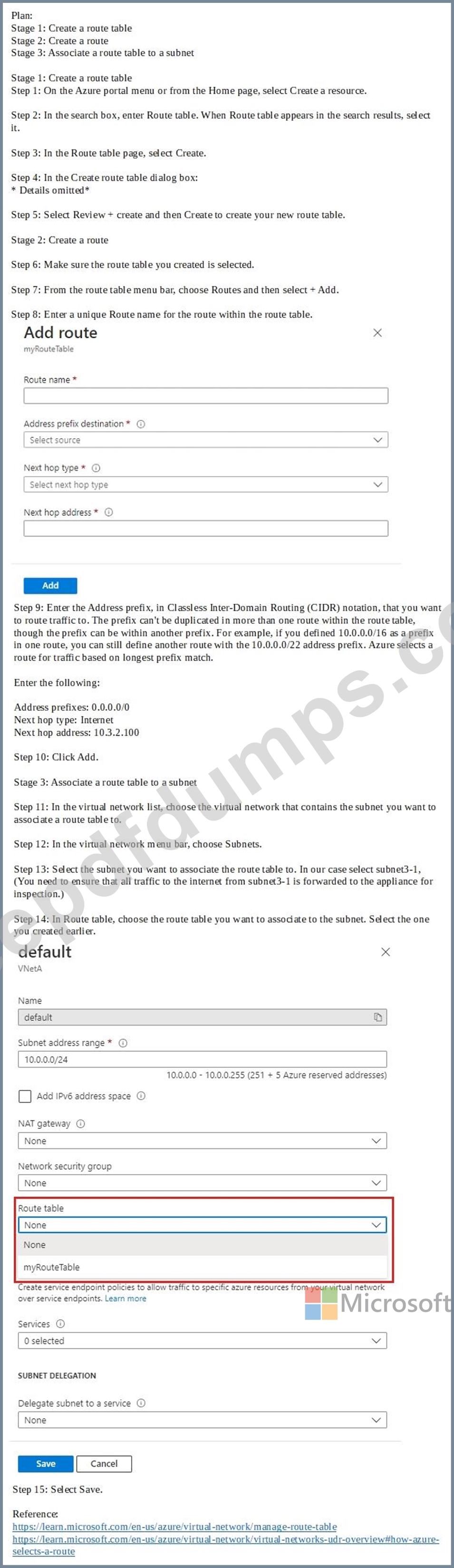
You plan to deploy an appliance to subnet3-2. The appliance will perform packet inspection and will have an IP address of 10.3.2.100.
You need to ensure that all traffic to the internet from subnet3-1 is forwarded to the appliance for inspection.
To complete this task, sign in to the Azure portal.
Username and password
Use the following login credentials as needed:
- To enter your username, place your cursor in the Sign in box and click on the username below.
- To enter your password, place your cursor in the Enter password box and click on the password below.
- Azure Username: [email protected]
- Azure Password: xxxxxxxxxx
If the Azure portal does not load successfully in the browser, press CTRL-K to reload the portal in a new browser tab.
The following information is for technical support purposes only:
- Lab Instance: 12345678
You plan to deploy an appliance to subnet3-2. The appliance will perform packet inspection and will have an IP address of 10.3.2.100.
You need to ensure that all traffic to the internet from subnet3-1 is forwarded to the appliance for inspection.
To complete this task, sign in to the Azure portal.
AZ-700 Exam Question 144
A listener is considered a logical entity responsible for checking the incoming connection requests with the help of the protocol, host, port, and IP address. When you decide to create a new listener, you have to choose between a basic and multi-site.
Scenario: You want that the incoming requests are forwarded to different backend pools depending upon the host names or host header.
Solution. You choose a Basic listener.
Is it the right choice?
Scenario: You want that the incoming requests are forwarded to different backend pools depending upon the host names or host header.
Solution. You choose a Basic listener.
Is it the right choice?
AZ-700 Exam Question 145
You have an Azure subscription that contains the following resources:
- A virtual network named Vnet1
- Two subnets named subnet1 and AzureFirewallSubnet
- A public Azure Firewall named FW1
- A route table named RT1 that is associated to Subnet1
- A rule routing of 0.0.0.0/0 to FW1 in RT1
After deploying 10 servers that run Windows Server to Subnet1, you discover that none of the virtual machine operating systems were activated.
You need to ensure that the virtual machines can be activated.
What should you do?
- A virtual network named Vnet1
- Two subnets named subnet1 and AzureFirewallSubnet
- A public Azure Firewall named FW1
- A route table named RT1 that is associated to Subnet1
- A rule routing of 0.0.0.0/0 to FW1 in RT1
After deploying 10 servers that run Windows Server to Subnet1, you discover that none of the virtual machine operating systems were activated.
You need to ensure that the virtual machines can be activated.
What should you do?