

AZ-801 Exam Question 106
You have an Azure subscription that uses Azure Monitor.
You need to create an alert rule that will generate an alert when an Azure virtual machine is turned off.
Which type of signal should you use?
You need to create an alert rule that will generate an alert when an Azure virtual machine is turned off.
Which type of signal should you use?
AZ-801 Exam Question 107
You have three servers named Server 1. Servers and Server3 that run Windows Server. The servers have the Hyper-V server rote installed and are configured in a Storage Spaces Deed cluster named Cluster1.
Cluster1 hosts a virtual machine named VM1 that has Windows Admin Center Installed.
You manage all servers and clusters by using Windows Admin Center.
You purchase an Azure subscription.
You need to configure email alerts in Azure Monitor for the following:
- Disk Capacity Utilization Over 80% for 10 Minutes
- Any critical alert in the cluster system event log
- Memory Utilization over 95% for 10 minutes
- Heartbeat fewer than 5 beats for 5 Minutes.
- CPU Utilization over 85 % for 10 Minutes.
- Any hearth service faults for the cluster
The solution must use the minimum amount of administrative effort.
What should you do?
Cluster1 hosts a virtual machine named VM1 that has Windows Admin Center Installed.
You manage all servers and clusters by using Windows Admin Center.
You purchase an Azure subscription.
You need to configure email alerts in Azure Monitor for the following:
- Disk Capacity Utilization Over 80% for 10 Minutes
- Any critical alert in the cluster system event log
- Memory Utilization over 95% for 10 minutes
- Heartbeat fewer than 5 beats for 5 Minutes.
- CPU Utilization over 85 % for 10 Minutes.
- Any hearth service faults for the cluster
The solution must use the minimum amount of administrative effort.
What should you do?
AZ-801 Exam Question 108
Drag and Drop Question
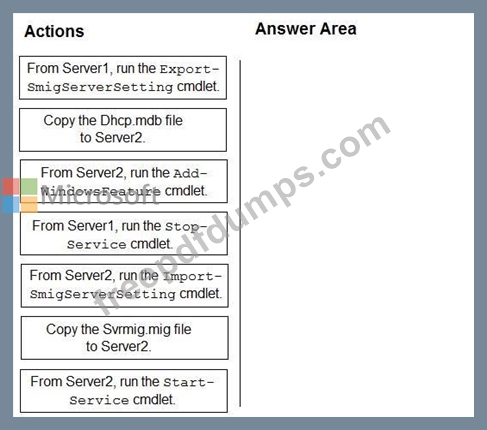
Your network contains an Active Directory Domain Services (AD DS) domain that contains the servers shown in the following table.

Server1 and Server2 are authorized as DHCP servers in the domain.
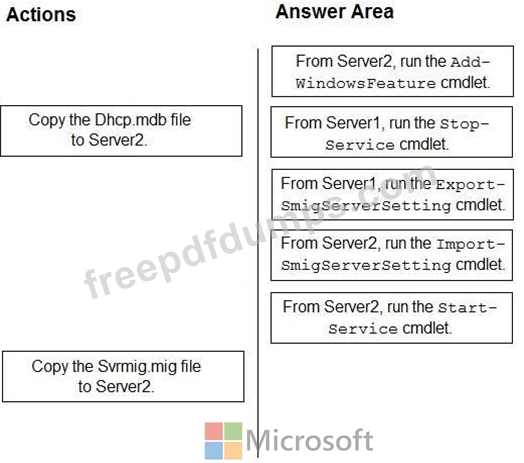
You need to migrate the DHCP Server role from Server1 to Server2.
Which five actions should you perform in sequence? To answer, move the appropriate actions from the list of actions to the answer area and arrange them in the correct order.
Your network contains an Active Directory Domain Services (AD DS) domain that contains the servers shown in the following table.
Server1 and Server2 are authorized as DHCP servers in the domain.
You need to migrate the DHCP Server role from Server1 to Server2.
Which five actions should you perform in sequence? To answer, move the appropriate actions from the list of actions to the answer area and arrange them in the correct order.
AZ-801 Exam Question 109
Hotspot Question
Your network contains an on-premises Active Directory Domain Services (AD DS) domain.
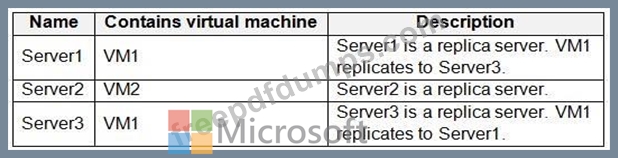
The domain contains the Hyper-V hosts shown in the following table.
Server1 has the Authorization and storage settings shown in the Server exhibit. (Click the Server1 tab.)
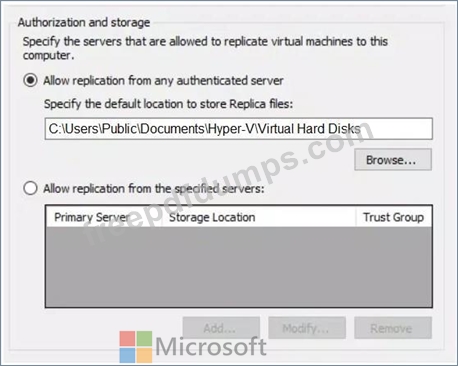
Server2 has the Authorization and storage settings shown in the Server2 exhibit. (Click the Server2 tab.)
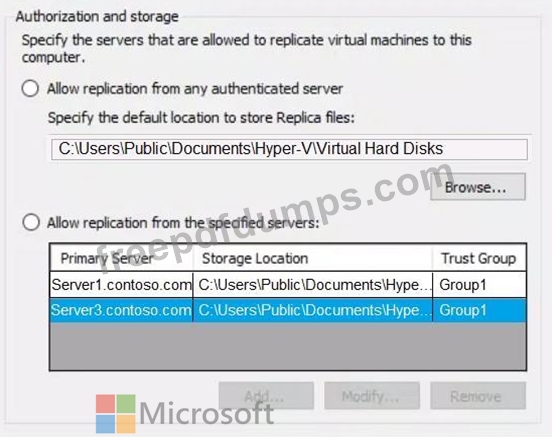
Server3 has the Authorization and storage settings shown in the Server3 exhibit. (Click the Server3 tab.)
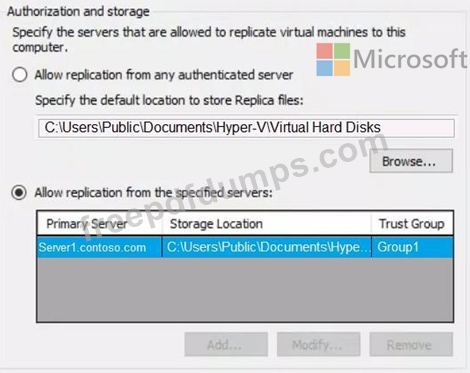
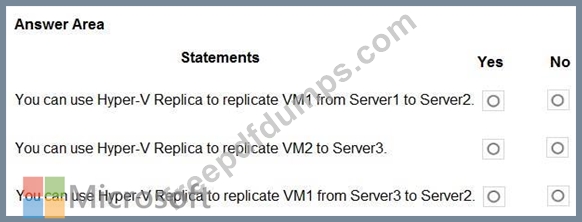
For each of the following statements, select Yes if the statement is true. Otherwise, select No.
NOTE: Each correct selection is worth one point.
Your network contains an on-premises Active Directory Domain Services (AD DS) domain.
The domain contains the Hyper-V hosts shown in the following table.
Server1 has the Authorization and storage settings shown in the Server exhibit. (Click the Server1 tab.)
Server2 has the Authorization and storage settings shown in the Server2 exhibit. (Click the Server2 tab.)
Server3 has the Authorization and storage settings shown in the Server3 exhibit. (Click the Server3 tab.)
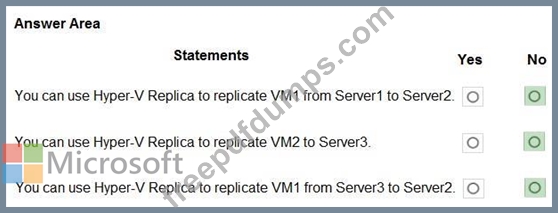
For each of the following statements, select Yes if the statement is true. Otherwise, select No.
NOTE: Each correct selection is worth one point.
AZ-801 Exam Question 110
Case Study 2 - Contoso, Ltd
Overview
Contoso, Ltd. is a manufacturing company that has a main office in Seattle and branch offices in Los Angeles and Montreal.
Existing Environment
Active Directory Environment
Contoso has an on-premises Active Directory Domain Services (AD DS) domain named contoso.com that syncs with an Azure Active Directory (Azure AD) tenant. The AD DS domain contains the domain controllers shown in the following table.

Contoso recently purchased an Azure subscription.
The functional level of the forest is Windows Server 2012 R2. The functional level of the domain is Windows Server 2012. The forest has the Active Directory Recycle Bin enabled.
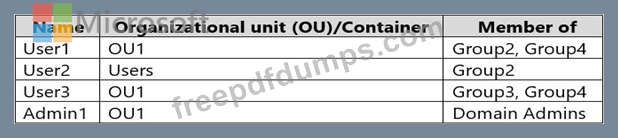
The contoso.com domain contains the users shown in the following table.
The contoso.com domain has the Group Policy Objects (GPOs) shown in the following table.

The contoso.com domain has the Password Settings Objects (PSOs) shown in the following table.

Server Infrastructure
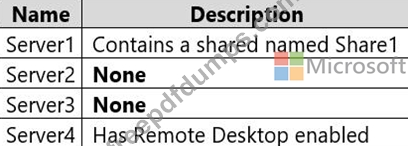
The contoso.com domain contains servers that run Windows Server 2022 as shown in the following table.
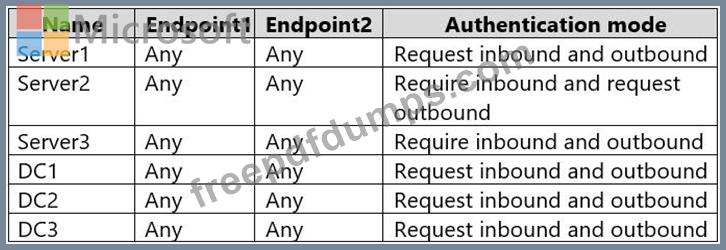
By using Windows Firewall with Advanced Security, the servers have isolation connection security rules configured as shown in the following table.
Server4 has no connection security rules.
Server4 Configurations
Server4 has the effective Group Policy settings for user rights as shown in the following table.

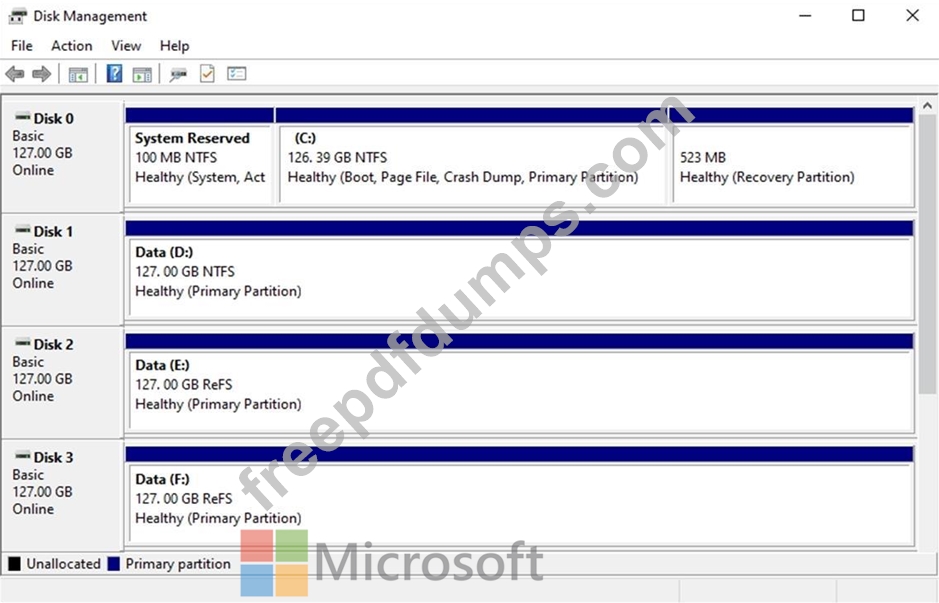
Server4 has the disk configurations shown in the following exhibit.
Virtualization Infrastructure
The contoso.com domain has the Hyper-V failover clusters shown in the following table.

Technical Requirements
Contoso identifies the following technical requirements:
* Promote a new server named DC4 that runs to Windows Server 2022 to a domain controller.
* Replicate the virtual machines from Cluster2 to an Azure Recovery Services vault.
* Centrally manage performance alerts in Azure for all the domain controllers.
* Ensure that User1 can recover objects from the Active Directory Recycle Bin.
* Migrate Share1 to Server2, including all the share and folder permissions.
* Back up Server4 and all data to an Azure Recovery Services vault.
* Use Hyper-V Replica to protect the virtual machines in Cluster3.
* Implement BitLocker Drive Encryption (BitLocker) on Server4.
* Whenever possible, use the principle of least privilege.
You need to meet the technical requirements for Cluster3.
What should you include in the solution?
Overview
Contoso, Ltd. is a manufacturing company that has a main office in Seattle and branch offices in Los Angeles and Montreal.
Existing Environment
Active Directory Environment
Contoso has an on-premises Active Directory Domain Services (AD DS) domain named contoso.com that syncs with an Azure Active Directory (Azure AD) tenant. The AD DS domain contains the domain controllers shown in the following table.
Contoso recently purchased an Azure subscription.
The functional level of the forest is Windows Server 2012 R2. The functional level of the domain is Windows Server 2012. The forest has the Active Directory Recycle Bin enabled.
The contoso.com domain contains the users shown in the following table.
The contoso.com domain has the Group Policy Objects (GPOs) shown in the following table.
The contoso.com domain has the Password Settings Objects (PSOs) shown in the following table.
Server Infrastructure
The contoso.com domain contains servers that run Windows Server 2022 as shown in the following table.
By using Windows Firewall with Advanced Security, the servers have isolation connection security rules configured as shown in the following table.
Server4 has no connection security rules.
Server4 Configurations
Server4 has the effective Group Policy settings for user rights as shown in the following table.
Server4 has the disk configurations shown in the following exhibit.
Virtualization Infrastructure
The contoso.com domain has the Hyper-V failover clusters shown in the following table.
Technical Requirements
Contoso identifies the following technical requirements:
* Promote a new server named DC4 that runs to Windows Server 2022 to a domain controller.
* Replicate the virtual machines from Cluster2 to an Azure Recovery Services vault.
* Centrally manage performance alerts in Azure for all the domain controllers.
* Ensure that User1 can recover objects from the Active Directory Recycle Bin.
* Migrate Share1 to Server2, including all the share and folder permissions.
* Back up Server4 and all data to an Azure Recovery Services vault.
* Use Hyper-V Replica to protect the virtual machines in Cluster3.
* Implement BitLocker Drive Encryption (BitLocker) on Server4.
* Whenever possible, use the principle of least privilege.
You need to meet the technical requirements for Cluster3.
What should you include in the solution?