

MD-100 Exam Question 86
Your network contains an Active Directory domain. The domain contains computers that run Windows 10.
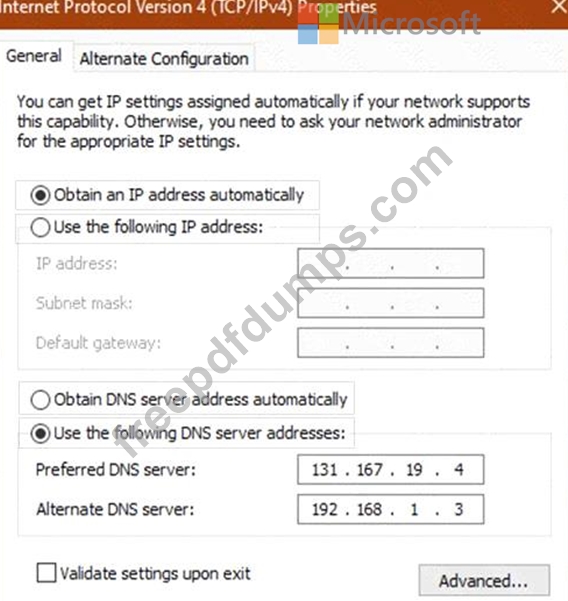
A user named Mia Hamm has a computer named Computer1. Mia Hamm reports that when she logs on to Computer1, she cannot access servers on the network but she can access computers on the internet.
You run the ipconfig command on Computer1 and receive the following output.

You successfully ping the default gateway, the DNS servers, and the DHCP server.
You need to resolve the connectivity problem on Computer1.
Which setting should you configure? To answer, select the appropriate options in the answer area.
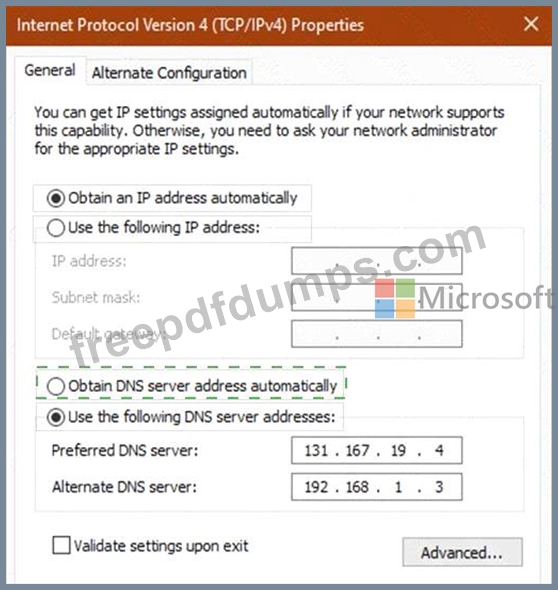
A user named Mia Hamm has a computer named Computer1. Mia Hamm reports that when she logs on to Computer1, she cannot access servers on the network but she can access computers on the internet.
You run the ipconfig command on Computer1 and receive the following output.
You successfully ping the default gateway, the DNS servers, and the DHCP server.
You need to resolve the connectivity problem on Computer1.
Which setting should you configure? To answer, select the appropriate options in the answer area.

MD-100 Exam Question 87
You have a computer named Client1 that runs Windows 11. You perform the following actions on Client1:
* Enable Hyper-V.
* Create a virtual machine that runs Windows 11 Pro.
You need to connect to VM1 by using enhanced session mode. What should you do first?
* Enable Hyper-V.
* Create a virtual machine that runs Windows 11 Pro.
You need to connect to VM1 by using enhanced session mode. What should you do first?
MD-100 Exam Question 88
You deploy 100 computers that run Windows 10. Each computer has a cellular connection and a Wi-Fi connection.
You need to prevent the computers from using the cellular connection unless a user manually connects to the cellular network.
What should you do?
You need to prevent the computers from using the cellular connection unless a user manually connects to the cellular network.
What should you do?
MD-100 Exam Question 89
Your domain contains named Computer named Computer1 that runs Windows 10. Computer1 does not have a TPM.
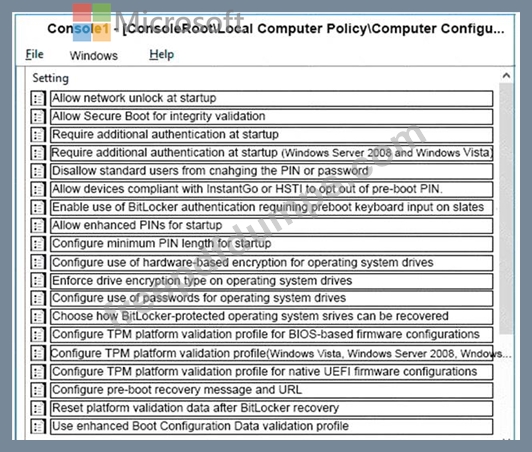
You need to be able to encrypt the C drive by using Bitlocker Drive Encryption (BitLocker). The solution must ensure that the recovery key is stored in Active Directory.
Which two Group Policy settings should you configure? To answer, select the appropriate settings in the answer area.
NOTE: Each correct selection is worth one point.
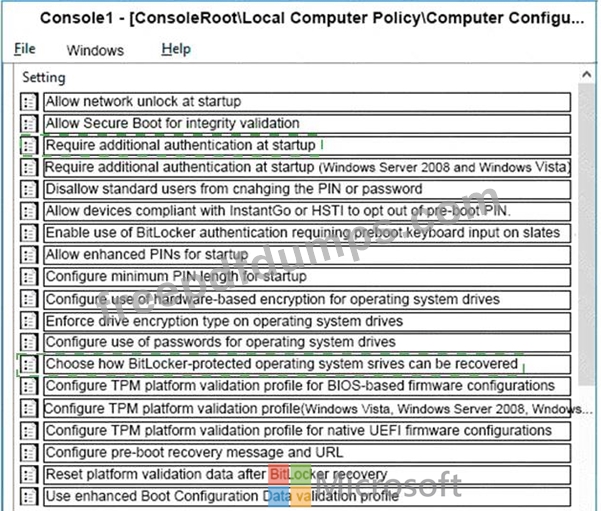
You need to be able to encrypt the C drive by using Bitlocker Drive Encryption (BitLocker). The solution must ensure that the recovery key is stored in Active Directory.
Which two Group Policy settings should you configure? To answer, select the appropriate settings in the answer area.
NOTE: Each correct selection is worth one point.

MD-100 Exam Question 90
Note: This question is part of a series of questions that present the same scenario. Each question in the series contains a unique solution that might meet the stated goals. Some question sets might have more than one correct solution, while others might not have a correct solution.
After you answer a question in this section, you will NOT be able to return to it. As a result, these questions will not appear in the review screen.
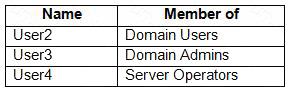
Your network contains an Active Directory domain named contoso.com. The domain contains the users shown in the following table.
You have a computer named Computer1 that runs Windows 10 and is in a workgroup.
A local standard user on Computer1 named User1 joins the computer to the domain and uses the credentials of User2 when prompted.
You need to ensure that you can rename Computer1 as Computer33.
Solution: You use the credentials of User3 on Computer1.
Does this meet the goal?
After you answer a question in this section, you will NOT be able to return to it. As a result, these questions will not appear in the review screen.
Your network contains an Active Directory domain named contoso.com. The domain contains the users shown in the following table.
You have a computer named Computer1 that runs Windows 10 and is in a workgroup.
A local standard user on Computer1 named User1 joins the computer to the domain and uses the credentials of User2 when prompted.
You need to ensure that you can rename Computer1 as Computer33.
Solution: You use the credentials of User3 on Computer1.
Does this meet the goal?