

1z0-071 Exam Question 141
View the Exhibit and examine the description of the EMPLOYEES table.
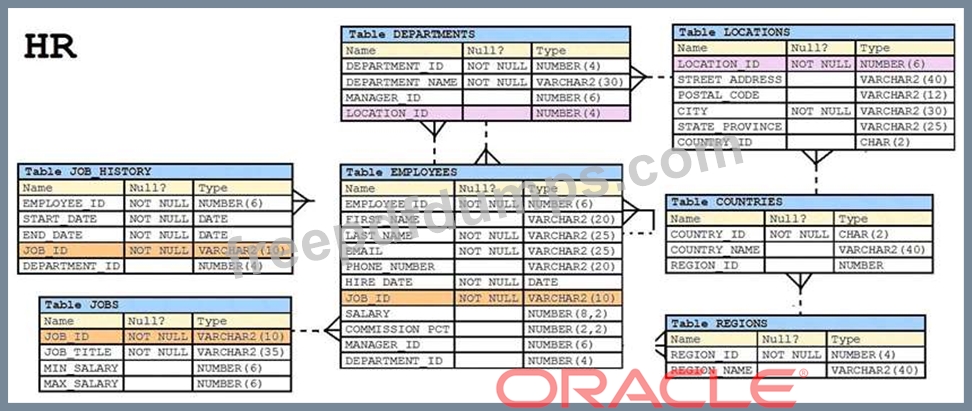
You want to calculate the total remuneration for each employee. Total remuneration is the sum of the annual salary and the percentage commission earned for a year. Only a few employees earn commission.
Which SQL statement would you execute to get the desired output?
You want to calculate the total remuneration for each employee. Total remuneration is the sum of the annual salary and the percentage commission earned for a year. Only a few employees earn commission.
Which SQL statement would you execute to get the desired output?
1z0-071 Exam Question 142
Sales data of a company is stored in two tables, SALES1 and SALES2, with some data being duplicated across the tables. You want to display the results from the SALES1 table, which are not present in the SALES2 table.
SALES1 table
NameNullType
-----------------------------------------------
SALES_IDNUMBER
STORE_IDNUMBER
ITEMS_IDNUMBER
QUANTITYNUMBER
SALES_DATEDATE
SALES2 table
NameNullType
----------------------------------------------
SALES_IDNUMBER
STORE_IDNUMBER
ITEMS_IDNUMBER
QUANTITYNUMBER
SALES_DATEDATE
Which set operator generates the required output?
SALES1 table
NameNullType
-----------------------------------------------
SALES_IDNUMBER
STORE_IDNUMBER
ITEMS_IDNUMBER
QUANTITYNUMBER
SALES_DATEDATE
SALES2 table
NameNullType
----------------------------------------------
SALES_IDNUMBER
STORE_IDNUMBER
ITEMS_IDNUMBER
QUANTITYNUMBER
SALES_DATEDATE
Which set operator generates the required output?
1z0-071 Exam Question 143
Examine the description of the CUSTOMERS table:

You want to display details of all customers who reside in cities starting with the letter D followed by at least two characters.
Which query can be used?
You want to display details of all customers who reside in cities starting with the letter D followed by at least two characters.
Which query can be used?
1z0-071 Exam Question 144
On your Oracle 12c database, you invoked SQL *Loader to load data into the EMPLOYEEStable in the HR schema by issuing the following command:
$> sqlldr hr/hr@pdb table=employees
Which two statements are true regarding the command? (Choose two.)
$> sqlldr hr/hr@pdb table=employees
Which two statements are true regarding the command? (Choose two.)
1z0-071 Exam Question 145
View the Exhibit and examine the description of the EMPLOYEES table.

Evaluate the following SQL statement:
SELECT first_name, employee_id, NEXT_DAY(ADD_MONTHS(hire_date, 6), 1) "Review" FROM employees; The query was written to retrieve the FIRST_NAME, EMPLOYEE_ID,and review date for employees. The review date is the firsts Monday after the completion of six months of the hiring. The NLS_TERRITORY parameter is set to AMERICAin the session.
Which statement is true regarding this query?
Evaluate the following SQL statement:
SELECT first_name, employee_id, NEXT_DAY(ADD_MONTHS(hire_date, 6), 1) "Review" FROM employees; The query was written to retrieve the FIRST_NAME, EMPLOYEE_ID,and review date for employees. The review date is the firsts Monday after the completion of six months of the hiring. The NLS_TERRITORY parameter is set to AMERICAin the session.
Which statement is true regarding this query?