Which two of the following are the key expected results of a quality management system that conforms to the requirements of ISO 9001:2015?
Correct Answer: A,E
The key expected results of a quality management system that conforms to the requirements of ISO 9001: 2015 are stated in clause 0.1 of the standard, which says: "The adoption of a quality management system is a strategic decision for an organization that can help to improve its overall performance and provide a sound basis for sustainable development initiatives. The potential benefits to an organization of implementing a quality management system based on this International Standard are: a) the ability to consistently provide products and services that meet customer and applicable statutory and regulatory requirements; b) facilitating opportunities to enhance customer satisfaction; c) addressing risks and opportunities associated with its context and objectives; d) the ability to demonstrate conformity to specified quality management system requirements." Therefore, the two options that best match these benefits are A and E, as they directly relate to providing products and services that meet customer requirements and enhancing customer satisfaction. The other options are not explicitly mentioned as key expected results, although they may be possible outcomes of implementing a quality management system. References: ISO 9001:2015 - Quality management systems - Requirements, Key Elements of an ISO 9001:2015 Quality Management System, What is ISO 9001 2015 as a Quality Management Systems?
ISO-9001-Lead-Auditor Exam Question 2
(When raising a non-conformity during an audit, which two of the following items should you include in the non-conformity statement?)
Correct Answer: D,E
ISO 9001:2015 requires that nonconformities be objective, evidence-based, and referenced against defined requirements, not personal, prescriptive, or solution-driven. When a nonconformity is raised, it must clearly show what requirement was not met and what objective evidence demonstrates this failure. # Why D (Audit criteria) is required * A nonconformity must reference the requirement that was not fulfilled (e.g., ISO 9001 clause, procedure, contract, or legal requirement). * ISO 9001 defines nonconformity as "non-fulfilment of a requirement". * Without audit criteria, there is no basis for declaring a nonconformity. # Supported by: * Clause 9.2.2 - Internal audits must determine whether the QMS conforms to requirements * Clause 10.2.2 - Documented information shall describe the nature of the nonconformity # Why E (Relevant audit evidence) is required * ISO 9001 requires decisions and conclusions (including audit findings) to be based on evidence. * Audit evidence ensures objectivity and prevents subjective or opinion-based findings. # Supported by: * Clause 9.1.3 - Analysis and evaluation shall be based on data and information * Clause 9.2.2 - Audit results must demonstrate conformity or nonconformity based on evidence # Why the other options are NOT correct * A (Name of person responsible)ISO 9001 focuses on system and process failures, not blaming individuals. * B (Target time for corrective action)This is part of corrective action planning, not the nonconformity statement itself (Clause 10.2). * C (Name of technical expert)ISO 9001 does not require identifying auditors or experts in the nonconformity statement. * F (Action to eliminate the nonconformity)Auditors must not prescribe solutions. The auditee determines corrective actions (Clause 10.2).
ISO-9001-Lead-Auditor Exam Question 3
Takitup is a small fabrication company that manufactures steel fencing, stairs and platforms for the construction sector. It has been certified to ISO 9001 for some time and has appointed a new Quality Manager. The audit plan during a surveillance audit is to cover the company's improvement actions and the auditor asks to see the most recent management review meeting minutes. Which two of the options would be relevant points for the auditor's checklist for the audit?
Correct Answer: A,E
ISO 9001:2015 requires top management to review the quality management system at planned intervals to ensure its continuing suitability, adequacy, effectiveness, and alignment with the strategic direction of the organisation . The auditor's focus, especially during a surveillance audit covering improvement actions , must therefore be on evidence that management review is being carried out correctly and that it results in QMS-related decisions and changes . Relevant ISO 9001 clauses include: * Clause 9.3.1 - Management review (General) Top management shall review the organisation's quality management system at planned intervals. * Clause 9.3.3 - Management review outputs The outputs of management review shall include decisions and actions related to opportunities for improvement and any need for changes to the QMS. Explanation of the correct options: A). The date of the most recent management review meeting This is directly relevant because ISO 9001 requires management reviews to occur at planned intervals . The auditor must confirm that the review has taken place and that it is current, especially during a surveillance audit. E). Changes made to the quality system by the new Quality Manager This is directly linked to management review outputs and improvement actions . Since a new Quality Manager has been appointed, the auditor must verify whether changes to the QMS were reviewed, approved, and monitored through management review in line with Clauses 9.3.3 and 10.3. Explanation of why the other options are not relevant: * B : Workforce redundancies are a human resources or business decision unless they directly affect QMS effectiveness, which is not indicated here. * C : Increased profitability is a business outcome, not a required management review input or output under ISO 9001. * D : Pension scheme improvements are unrelated to QMS performance or improvement. * F : A bonus scheme may relate to productivity, but unless it directly affects QMS objectives or process performance reviewed in management review, it is not a required checklist item. ISO-aligned conclusion: For an audit focusing on improvement actions and management review , the auditor's checklist should confirm: * That management review has been conducted as required, and * That QMS-related changes and improvements (especially under a new Quality Manager) are being reviewed and controlled.
ISO-9001-Lead-Auditor Exam Question 4
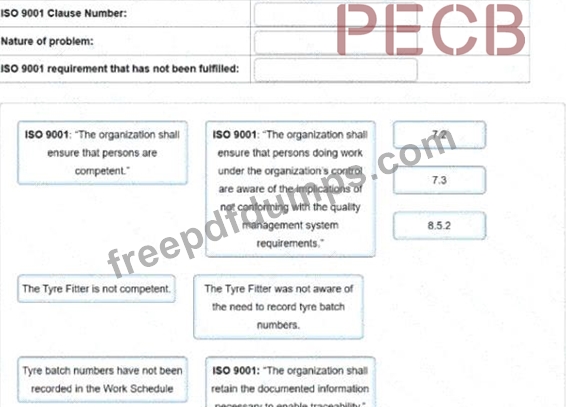
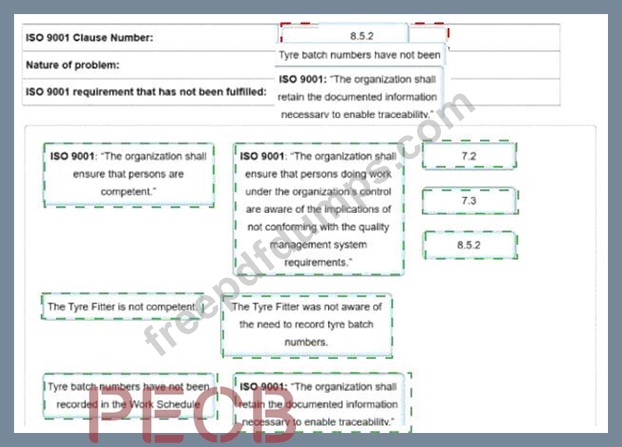
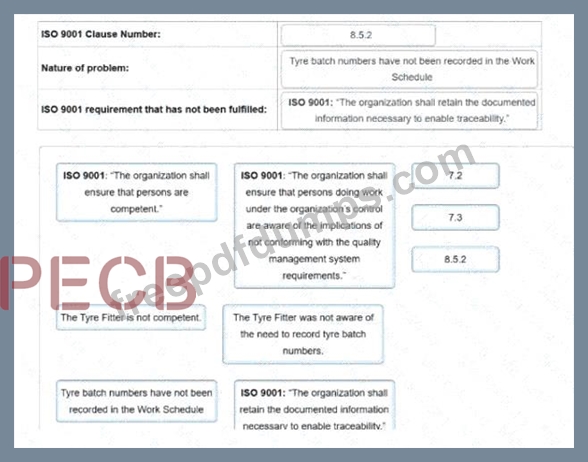
To complete the non-conformity report, click on the blank section you want to complete so it is highlighted in red and then click on the applicable text from the options below. Alternatively, drag and drop the options to the appropriate blank section.
Correct Answer:
ISO-9001-Lead-Auditor Exam Question 5
You have been just hired as the Internal Lead Auditor of a large organisation, responsible for internal audits. Your first job is to analyse the answers to nonconformities included in the report of a recent internal audit to Top Management. The report contained one nonconformity as follows: There is no evidence of Top Management ensuring the availability of resources to operate the QMS, the establishment of objectives, the promotion of continual improvement, and the promoting of the process approach. Which four of the following Top Management actions can be considered 'corrections to the nonconformity'?