

CAPM Exam Question 126
An input of the Control Schedule process is the:
Correct Answer: D
According to the PMBOK Guide, the Control Schedule process is the process of monitoring the status of the project to update the project schedule and manage changes to the schedule baseline. To perform this effectively, the project manager must utilize existing organizational frameworks.
* Organizational Process Assets (OPAs): These are internal to the performing organization and serve as a formal input to the Control Schedule process. They provide the necessary context and tools for monitoring time-related performance.
* Specific Examples: OPAs include existing formal and informal schedule control-related policies, procedures, and guidelines; schedule control tools used by the organization; and monitoring and reporting methods to be used (such as specific software or reporting templates).
* Other Key Inputs:
* Project Management Plan: Contains the schedule management plan and the schedule baseline (the version against which actual progress is compared).
* Project Documents: Including the project schedule, resource calendars, and schedule data.
* Work Performance Data: Raw observations and measurements identified during activities being performed to carry out the project work (e.g., actual start and finish dates).
Comparison with other options:
* A. resource calendar: While the resource calendar is a project document that can be an input to Control Schedule, the question asks for a specific category or standard input. In the formal input list for Control Schedule, Organizational Process Assets is a mandatory and broader category defined in the PMBOK framework for this process.
* B. activity list: This is an output of the Define Activities process and is primarily used as an input for estimating and sequencing. While it exists during the control phase, it is not listed as a primary direct input for the specific mechanics of controlling the schedule.
* C. risk management plan: This plan describes how risk management activities will be structured. While risks affect the schedule, the Risk Register (which contains specific threats to the timeline) is a more direct document used in monitoring, whereas the plan itself is not a primary input for the Control Schedule process.
CAPM Exam Question 127
Plan-do-check-act is also known as:
Correct Answer: D
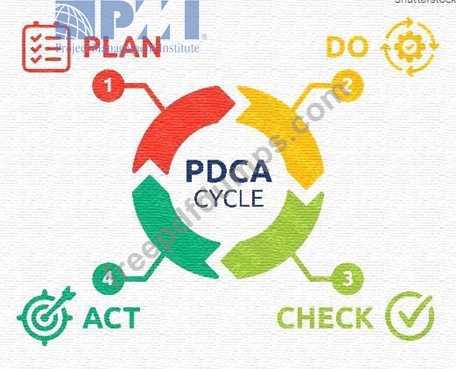
According to the PMBOKGuide, the Plan-Do-Check-Act (PDCA) cycle is a fundamental concept in Project Quality Management. It was popularized by W. Edwards Deming and is the basis for continuous improvement (also known as Kaizen).
The PDCA Cycle:
* Plan: Establish the objectives and processes necessary to deliver results in accordance with the expected output.
* Do: Implement the plan, execute the process, and make the product.
* Check: Study the actual results (measured and collected in " Do " ) and compare against the expected results to ascertain any differences.
* Act: Request corrective actions on significant differences between actual and planned results.
Analyze the differences to determine their root causes.
* Relationship to Project Management: The PDCA cycle is highly compatible with the Project Management Process Groups. For example, the Planning process group corresponds to " Plan, " Executing to " Do, " Monitoring and Controlling to " Check " and " Act. "
* Continuous Improvement: By repeatedly cycling through these four steps, an organization or project team can ensure that processes are constantly being refined, efficiency is increasing, and quality is consistently improving.
Analysis of Other Options:
A). prevention over inspection: This is a quality management principle which states that quality should be planned, designed, and built-in-not inspected-in. While PDCA helps achieve this, it is not the name for the PDCA cycle itself.
* B. statistical sampling: This is a tool and technique used in Quality Control to choose part of a population of interest for inspection.
* C. management responsibility: This is a concept emphasizing that the success of quality management requires the participation of all members of the team but remains the ultimate responsibility of management to provide the resources needed for success.
The PDCA Cycle:
* Plan: Establish the objectives and processes necessary to deliver results in accordance with the expected output.
* Do: Implement the plan, execute the process, and make the product.
* Check: Study the actual results (measured and collected in " Do " ) and compare against the expected results to ascertain any differences.
* Act: Request corrective actions on significant differences between actual and planned results.
Analyze the differences to determine their root causes.
* Relationship to Project Management: The PDCA cycle is highly compatible with the Project Management Process Groups. For example, the Planning process group corresponds to " Plan, " Executing to " Do, " Monitoring and Controlling to " Check " and " Act. "
* Continuous Improvement: By repeatedly cycling through these four steps, an organization or project team can ensure that processes are constantly being refined, efficiency is increasing, and quality is consistently improving.
Analysis of Other Options:
A). prevention over inspection: This is a quality management principle which states that quality should be planned, designed, and built-in-not inspected-in. While PDCA helps achieve this, it is not the name for the PDCA cycle itself.
* B. statistical sampling: This is a tool and technique used in Quality Control to choose part of a population of interest for inspection.
* C. management responsibility: This is a concept emphasizing that the success of quality management requires the participation of all members of the team but remains the ultimate responsibility of management to provide the resources needed for success.
CAPM Exam Question 128
A project is composed of three phases that are implemented in parallel without affecting one another. The baselines for each individual phase have been approved by the major stakeholders, and there is a minimal ability to vary the baselines during the execution of the project.
Which methodology did the project manager adopt?
Which methodology did the project manager adopt?
Correct Answer: B
According to the PMBOK Guide and the Agile Practice Guide, the choice of methodology is dictated by the stability of the requirements and the flexibility of the baselines.
Predictive (Traditional/Waterfall) Characteristics: The key indicators in this scenario are that the baselines have been approved and there is minimal ability to vary them. In a predictive approach, the scope, schedule, and cost are determined early in the project life cycle. Any changes to these baselines typically require formal change control.
Parallel Phases: While predictive projects are often thought of as purely sequential, the PMBOK Guide notes that phases can be overlapped (fast-tracked) or run in parallel to compress the schedule, provided the requirements are well-understood.
Minimal Variance: The " minimal ability to vary the baselines " is the hallmark of a predictive environment.
Unlike adaptive or iterative models where the plan is expected to evolve, a predictive approach seeks to manage the project against a fixed plan to ensure high levels of certainty and control.
Analysis of other options:
Option A: An Incremental approach delivers functional portions of the project in parts. While it uses fixed baselines for each increment, it is usually focused on frequent delivery of working products rather than parallel phases with rigid, unvarying baselines for the whole project.
Option C: A Hybrid approach combines predictive and adaptive elements. Since this scenario emphasizes " minimal ability to vary " and does not mention any adaptive or agile components, " Predictive " is a more accurate fit.
Option D: An Iterative approach focuses on repeating activities until the product is " correct. " It explicitly allows for-and expects-the baselines to vary and evolve as the team learns more through each cycle.
Per PMI standards, a methodology characterized by pre-approved, rigid baselines with restricted change during execution is defined as a Predictive approach.
CAPM Exam Question 129
Which tool uses an algorithm based on historical data to calculate cost?
Correct Answer: B
According to the PMBOK Guide, specifically within the Estimate Costs and Estimate Activity Durations processes, Parametric Estimating is a highly accurate technique that uses a statistical relationship between historical data and other variables.
How the Algorithm Works: This technique calculates cost or duration based on historical data and project parameters. It identifies a " unit " (e.g., cost per square foot, lines of code, or hours per installation) and multiplies it by the quantity required for the current project.
Formula Example: $Total Cost = (Cost per Unit) \times (Number of Units)$.
Higher Accuracy: Because it is based on quantitative data and mathematical models, it is generally more accurate than analogous estimating, provided the underlying data is reliable.
Application: It can be applied to entire projects or specific levels of a project, and it is often used in construction, software development, and manufacturing where standardized units of work are common.
Analysis of other options:
Three-point estimating (Option A): This uses three values (Optimistic, Most Likely, and Pessimistic) to calculate an average ($Expected = \frac{O + M + P}{3}$ or the Beta/PERT distribution). While it uses math, it is based on expert judgment of range rather than a standardized historical algorithm per unit.
Analogous estimating (Option B): This uses the actual cost/duration of a previous, similar project as the basis for estimating the current one. It is a " top-down " approach and is considered a form of expert judgment. It is faster and less costly than parametric but also less accurate because it doesn ' t use a granular algorithm.
Relative estimating (Option D): Common in Agile (e.g., Story Points), this involves comparing the size of a task to other tasks rather than using historical data algorithms to find an absolute cost.
Per PMI standards, Parametric Estimating is the preferred method when historical data is available and the relationship between variables can be quantified, as it provides a data-driven foundation for the Cost Baseline.
CAPM Exam Question 130
Which activity is an input to the Conduct Procurements process?
Correct Answer: A
According to the PMBOKGuide, the Conduct Procurements process is the process of obtaining seller responses, selecting a seller, and awarding a contract.
* Organizational Process Assets (OPAs): These are internal to the organization and serve as a primary input to the Conduct Procurements process. They provide the framework and historical data necessary to execute the procurement successfully.
* Specific Examples: OPAs include a list of preferred sellers (vetted vendors), specialized procurement policies, established templates for contracts or evaluation criteria, and historical information from previous procurement activities that can help in selecting the right bidder.
* Other Key Inputs:
* Project Management Plan: Includes the procurement management plan and scope baseline.
* Project Documents: Such as the lessons learned register, project schedule, and requirements documentation.
* Procurement Documentation: Including the bid documents (RFP/RFQ), Statement of Work (SOW), and independent cost estimates.
* Seller Proposals: The formal responses from vendors being evaluated.
Comparison with other options:
* B. Resource availability: This is typically an output of the Acquire Resources process (representing the physical or human resources assigned to the project). While procurement involves external resources, " Resource Availability " as a specific document/status is not a formal input for Conducting Procurements.
* C. Perform Integrated Change Control: This is a process, not an input. While change requests from Conduct Procurements are sent to this process, the process itself is not an input to procurement activities.
* D. Team performance assessment: This is an output of the Develop Team process. It measures the effectiveness of the project team ' s performance and is not used as a criterion or input for selecting external sellers during procurement.
- Other Version
- 4395PMI.CAPM.v2026-09-05.q632
- 6047PMI.CAPM.v2026-07-17.q643
- 5835PMI.CAPM.v2023-02-14.q281
- 12602PMI.CAPM.v2022-05-24.q570
- 59PMI.Pass4guide.CAPM.v2022-05-12.by.shirley.570q.pdf
- 15450PMI.CAPM.v2022-01-02.q768
- 89PMI.Exams4sures.CAPM.v2021-08-25.by.odelette.722q.pdf
- Latest Upload
- 173Salesforce.Analytics-Admn-201.v2026-11-28.q33
- 234Splunk.SPLK-3003.v2026-11-28.q71
- 212Salesforce.Slack-Dev-201.v2026-11-28.q54
- 278PMI.PMP.v2026-11-27.q87
- 251Microsoft.AI-901.v2026-11-27.q70
- 342Huawei.H12-821_V1.0.v2026-11-27.q165
- 413Microsoft.MS-102.v2026-11-26.q270
- 264Salesforce.OmniStudio-Consultant.v2026-11-25.q93
- 594IIA.IIA-CIA-Part3-CN.v2026-11-24.q351
- 377Microsoft.AZ-801.v2026-11-24.q144