

CAPM Exam Question 136
Construction of a building has stopped due to a supplier ' s failure to deliver concrete. The project schedule is behind by three months.
What should the project manager do to overcome this problem and put the project back on track?
What should the project manager do to overcome this problem and put the project back on track?
Correct Answer: A
According to the PMBOK Guide, specifically within the Monitor Risks and Implement Risk Responses processes, a project manager must act decisively when a known or unknown risk materializes into an issue.
Why Choice A is correct:
Risk Response Implementation: A professional project manager should have identified " supplier failure " as a potential risk during the planning phase. The Risk Register would contain a pre-approved Risk Response Plan (e.g., a secondary supplier, expedited shipping, or technical alternatives).
Resource Allocation: To address a three-month delay, the PM may need to utilize contingency reserves or reallocate human and material resources to perform " crashing " or " fast-tracking " once the concrete arrives to compress the schedule.
Structured Approach: Following the plan ensures that the response is calculated and authorized, rather than reactive or emotional.
Analysis of other options:
B (Consult legal/SMEs to avoid failure): While legal advice might be necessary for contract breaches, the primary goal of the PM is to " put the project back on track. " Legal action is a recovery of damages, not a schedule recovery technique. Furthermore, " avoiding failure " is proactive; the failure has already occurred, so the PM must now move to mitigation or corrective action.
C (Extend delivery and use management reserve): Management reserves are typically for " unknown- unknowns " and require senior management approval. Simply extending the deadline is a passive move that doesn ' t " overcome " the problem or put the project " back on track " -it simply moves the goalposts.
D (Accept penalties): This is a " passive acceptance " strategy. In a high-impact scenario like a three-month construction delay, passive acceptance is rarely acceptable to stakeholders. The PM is expected to explore all possible corrective actions before resigning to penalties.
Key Concept: The Project Management Institute (PMI) emphasizes that the Risk Register is a living document. When an issue occurs, the PM evaluates the effectiveness of the planned response. If the original plan is insufficient, the PM should issue a Change Request to implement more aggressive recovery measures, ensuring the project aligns as closely as possible with the original Schedule Baseline.
CAPM Exam Question 137
The project manager is dividing the project scope into smaller pieces, and repeating this process until no more subdivisions are required. At this point the project manager is able to estimate costs and activities for each element.
What are these elements called?
What are these elements called?
Correct Answer: B
According to the PMBOKGuide, the process described is Decomposition, which is the primary technique used in the Create WBS (Work Breakdown Structure) process.
* Definition of a Work Package: A work package is the lowest level of the Work Breakdown Structure. It is the point at which the cost and duration for the work can be reliably estimated and managed.
* The Goal of Decomposition: The project manager subdivides project deliverables into smaller, more manageable components. This process continues until the work is defined at a level of detail that allows for:
* Cost Estimation: Assigning a specific budget to the work.
* Activity Definition: Breaking the work package further into schedule activities.
* Monitoring and Control: Tracking progress against a specific baseline.
* The 8/80 Rule: A common heuristic in project management is that a work package should be between 8 and 80 hours of effort. If it is larger, it may need further decomposition; if it is smaller, it might be too granular for the WBS level.
Analysis of Other Options:
* A. Project activities: These are even smaller than work packages. Activities are the specific actions required to produce a work package. They are defined during the Define Activities process (part of Schedule Management), not during the creation of the WBS (Scope Management).
* C. Planning packages: These are components of the WBS that are below the control account but above the work package level. They have known work content but lack detailed schedule activities. They are used for " Rolling Wave Planning " when details for a specific part of the project are not yet available.
* D. Project deliverables: While work packages are deliverables, " deliverables " is a broad term that applies to any unique and verifiable product, result, or capability. The specific " elements " at the lowest level of the WBS resulting from decomposition are strictly defined as work packages.
CAPM Exam Question 138
How should a stakeholder who is classified as high power and low interest be grouped in a power/interest grid during stakeholder analysis?
Correct Answer: A
According to the PMBOK Guide, specifically within the Identify Stakeholders process, the Power/Interest Grid is a categorization tool used to group stakeholders based on their level of authority (power) and their level of concern (interest) regarding project outcomes.
* High Power / Low Interest: Stakeholders in this quadrant have significant influence over the project ' s resources or direction but do not have a high level of active interest in the day-to-day details.
* Engagement Strategy: The recommended strategy for these individuals is to Keep Satisfied. Because of their high power, they have the ability to derail a project if they become unhappy or if their high-level needs are not met. However, because their interest is low, providing them with too much detailed information could overwhelm or annoy them.
* Examples: This often includes senior executives, government regulators, or department heads who provide funding but are not directly involved in the project ' s execution.
Analysis of Other Options:
* B. Keep informed: This strategy is used for stakeholders with Low Power but High Interest. These people are interested in the project ' s progress and can often provide helpful details, but they lack the authority to make major changes.
* C. Manage closely: This is the strategy for the " Key Players " -those with both High Power and High Interest. They require the highest level of engagement and frequent communication.
* D. Monitor: This strategy is reserved for stakeholders with Low Power and Low Interest. They require the least effort; the project team simply monitors them to see if their power or interest levels change over time.
CAPM Exam Question 139
What process is performed periodically throughout the project as needed?
Correct Answer: A
According to the PMBOK Guide, the process of Plan Risk Management-and the overall management of risks-is not a one-time event during the planning phase. Instead, it is a process that is performed periodically throughout the project as needed.
* Continuous Nature of Risk: Risks are dynamic. New risks may emerge, and existing risks may change or disappear as the project progresses through different phases. Therefore, the approach to managing risk must be revisited to ensure it remains appropriate for the project ' s current context.
* Process Frequency: While many planning processes are primarily focused at the start of a phase, the PMI framework explicitly identifies Risk Management processes as being iterative. The Plan Risk Management process defines how risk management activities will be structured and performed; as the project ' s complexity or stakeholder risk appetite changes, this plan may need adjustment.
* Integration with Project Life Cycle: During phase transitions or after significant changes (such as a major scope change), the project manager must re-evaluate the risk management framework to ensure it is still robust enough to protect the project's objectives.
Why other options are incorrect:
* Option B: Plan Communications Management: This process is primarily performed at predefined points in the project (usually at the beginning or during phase starts). While it is updated if communication needs change, it is not characterized in the PMBOK Guide as a process performed " periodically as needed " in the same iterative sense as risk management.
* Option C: Plan Resource Management: Similar to communications, resource planning is typically focused at the start of the project or phase to establish the " how-to " for acquiring and managing the team.
* Option D: Plan Cost Management: This is a foundational planning process performed at a discrete point early in the project to establish the policies for estimating, budgeting, and controlling costs. It is rarely revisited " periodically " unless there is a fundamental shift in the organization ' s financial policies or a total project re-baselining.
CAPM Exam Question 140
Conflict should be best addressed in which manner?
Correct Answer: A
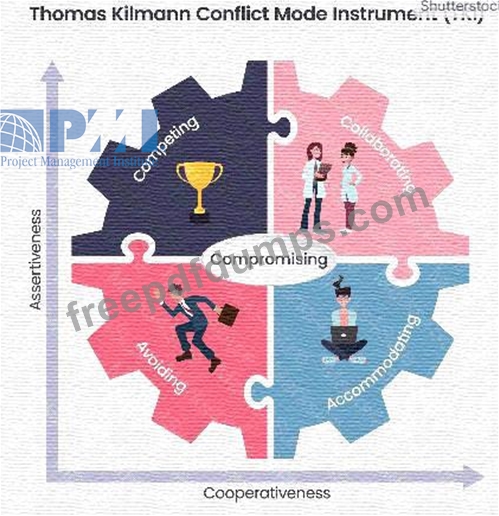
According to the PMBOKGuide, specifically within the Manage Project Team process, conflict management is a key tool and technique. Conflict is inevitable in a project environment, but how it is handled determines whether it becomes a functional or dysfunctional force.
Timing (Early): Conflicts should be addressed early. Proactive management prevents minor disagreements from escalating into major issues that could impact team morale, productivity, and the project schedule.
* Setting (In Private): As a general rule, conflict should be addressed in private. Handling disagreements away from the larger group or stakeholders protects the professional reputation of the individuals involved and fosters a safer environment for honest communication.
* Approach (Direct/Collaborative): The most effective method for long-term resolution is a direct, collaborative approach (also known as the Problem Solving or Confronting technique). This involves treating the conflict as a problem to be solved, examining alternatives, and requiring a " give-and-take " attitude from all parties to reach a consensus.
Analysis of other choices:
Choice B (Early, in public, using an indirect, collaborative approach): While " early " and " collaborative " are positive, " in public " is generally discouraged as it can lead to defensiveness, embarrassment, and a breakdown in team trust.
* Choice C (Early, in private, using an indirect, cooperative approach): " Indirect " or " cooperative " (often associated with Smoothing or Accommodating) may provide temporary relief but often fails to address the root cause of the conflict, leading to the issue resurfacing later.
* Choice D (As late as possible, in public, using a direct, confrontational approach): This is the least desirable method. Waiting " as late as possible " allows the conflict to fester, while " public " and " confrontational " (associated with Forcing) usually results in a win-lose situation that damages long- term team dynamics.
Timing (Early): Conflicts should be addressed early. Proactive management prevents minor disagreements from escalating into major issues that could impact team morale, productivity, and the project schedule.
* Setting (In Private): As a general rule, conflict should be addressed in private. Handling disagreements away from the larger group or stakeholders protects the professional reputation of the individuals involved and fosters a safer environment for honest communication.
* Approach (Direct/Collaborative): The most effective method for long-term resolution is a direct, collaborative approach (also known as the Problem Solving or Confronting technique). This involves treating the conflict as a problem to be solved, examining alternatives, and requiring a " give-and-take " attitude from all parties to reach a consensus.
Analysis of other choices:
Choice B (Early, in public, using an indirect, collaborative approach): While " early " and " collaborative " are positive, " in public " is generally discouraged as it can lead to defensiveness, embarrassment, and a breakdown in team trust.
* Choice C (Early, in private, using an indirect, cooperative approach): " Indirect " or " cooperative " (often associated with Smoothing or Accommodating) may provide temporary relief but often fails to address the root cause of the conflict, leading to the issue resurfacing later.
* Choice D (As late as possible, in public, using a direct, confrontational approach): This is the least desirable method. Waiting " as late as possible " allows the conflict to fester, while " public " and " confrontational " (associated with Forcing) usually results in a win-lose situation that damages long- term team dynamics.
- Other Version
- 4395PMI.CAPM.v2026-09-05.q632
- 6047PMI.CAPM.v2026-07-17.q643
- 5835PMI.CAPM.v2023-02-14.q281
- 12602PMI.CAPM.v2022-05-24.q570
- 59PMI.Pass4guide.CAPM.v2022-05-12.by.shirley.570q.pdf
- 15450PMI.CAPM.v2022-01-02.q768
- 89PMI.Exams4sures.CAPM.v2021-08-25.by.odelette.722q.pdf
- Latest Upload
- 173Salesforce.Analytics-Admn-201.v2026-11-28.q33
- 234Splunk.SPLK-3003.v2026-11-28.q71
- 212Salesforce.Slack-Dev-201.v2026-11-28.q54
- 278PMI.PMP.v2026-11-27.q87
- 251Microsoft.AI-901.v2026-11-27.q70
- 342Huawei.H12-821_V1.0.v2026-11-27.q165
- 413Microsoft.MS-102.v2026-11-26.q270
- 264Salesforce.OmniStudio-Consultant.v2026-11-25.q93
- 594IIA.IIA-CIA-Part3-CN.v2026-11-24.q351
- 377Microsoft.AZ-801.v2026-11-24.q144