

CAPM Exam Question 296
What should a project manager do to prepare a risk management plan with a lot of technical uncertainty?
Correct Answer: A
According to the PMBOKGuide, specifically the Plan Risk Management process, when a project manager faces high levels of technical uncertainty, they must rely on specialized knowledge to identify, analyze, and plan for potential risks.
* Expert Judgment (Choice A): This is a primary Tool and Technique for all risk processes. When the project involves complex technical components, the project manager should consult with subject matter experts (SMEs), specialized consultants, or technical leads. These experts can provide insight based on similar past projects or specialized training to help define the risk management approach, set the appropriate thresholds, and identify specific technical " red flags " that a non-specialist might miss.
* Personal Experience (Choice B): While a project manager's experience is valuable, relying solely on it-especially in a project with high technical uncertainty-is dangerous. It can lead to cognitive biases or blind spots regarding new technologies or specialized environments where the PM may not have direct expertise.
* Asking Project Sponsors (Choice C): Sponsors provide high-level strategic direction and funding.
While they may define the organization's overall risk appetite, they are typically not the correct source for resolving specific technical uncertainties.
* Delaying the Project (Choice D): This is generally not an option in professional project management.
The purpose of Project Risk Management is to manage uncertainty as it exists. Waiting for 100% clarity would result in " analysis paralysis, " as some uncertainties are only resolved through the execution of the project itself.
By utilizing Expert Judgment, the project manager ensures that the Risk Management Plan is robust, realistic, and tailored to the technical complexities of the project, allowing the team to proactively address potential issues rather than merely reacting to them.
CAPM Exam Question 297
Which conflict resolution technique produces the most lasting results?
Correct Answer: D
According to the PMBOKGuide (6th Edition), there are five general techniques used to resolve conflict.
Each has its place depending on the situation, but Collaborate/Problem Solve is considered the most effective for achieving long-term, sustainable results.
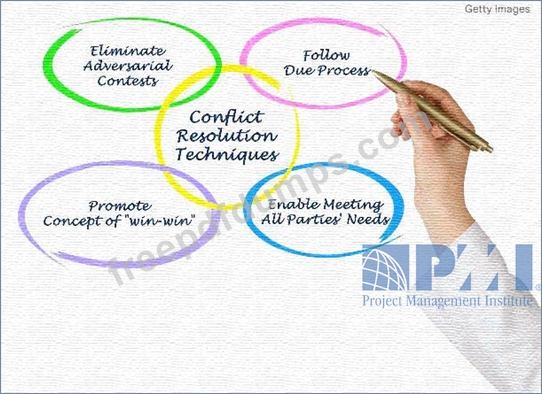
Collaborate/Problem Solve involves incorporating multiple viewpoints and insights from differing perspectives. It requires a cooperative attitude and open dialogue that typically leads to consensus and commitment. This technique is often referred to as a win-win solution.
Why it produces the most lasting results:
Root Cause Focus: Unlike other methods that may only address symptoms, collaboration seeks to identify and resolve the underlying problem.
* Buy-in: Because all parties participate in the solution, they are more likely to support the outcome, reducing the chance of the conflict resurfacing.
* Relationship Building: It fosters trust and improves team dynamics by treating conflict as an opportunity for improvement rather than a battle to be won.
Analysis of Distractors:
A (Withdraw/avoid): This involves retreating from a conflict or postponing the issue. It is a lose-leave approach that fails to solve the problem, often allowing it to worsen over time.
* B (Smooth/accommodate): This emphasizes areas of agreement rather than areas of difference, conceding one ' s position to maintain harmony. It is a temporary fix (a " band-aid " ) that does not address the core issue.
* C (Compromise/reconcile): This involves searching for solutions that bring some degree of satisfaction to all parties but requires everyone to give something up. This is a lose-lose or " middle ground " approach that can lead to lingering dissatisfaction.
Each has its place depending on the situation, but Collaborate/Problem Solve is considered the most effective for achieving long-term, sustainable results.
Collaborate/Problem Solve involves incorporating multiple viewpoints and insights from differing perspectives. It requires a cooperative attitude and open dialogue that typically leads to consensus and commitment. This technique is often referred to as a win-win solution.
Why it produces the most lasting results:
Root Cause Focus: Unlike other methods that may only address symptoms, collaboration seeks to identify and resolve the underlying problem.
* Buy-in: Because all parties participate in the solution, they are more likely to support the outcome, reducing the chance of the conflict resurfacing.
* Relationship Building: It fosters trust and improves team dynamics by treating conflict as an opportunity for improvement rather than a battle to be won.
Analysis of Distractors:
A (Withdraw/avoid): This involves retreating from a conflict or postponing the issue. It is a lose-leave approach that fails to solve the problem, often allowing it to worsen over time.
* B (Smooth/accommodate): This emphasizes areas of agreement rather than areas of difference, conceding one ' s position to maintain harmony. It is a temporary fix (a " band-aid " ) that does not address the core issue.
* C (Compromise/reconcile): This involves searching for solutions that bring some degree of satisfaction to all parties but requires everyone to give something up. This is a lose-lose or " middle ground " approach that can lead to lingering dissatisfaction.
CAPM Exam Question 298
A project manager needs to tailor the Project Cost Management process. Which considerations should the project manager apply?
Correct Answer: D
According to the PMBOKGuide, specifically in the introduction to the Project Cost Management knowledge area, the project manager is responsible for tailoring the processes to fit the unique needs of the project. This is because each project is different, and the rigor of cost management should be commensurate with the project ' s size, complexity, and importance.
One of the key considerations for tailoring identified by PMI for Cost Management is Knowledge Management. The project manager should consider:
* Organizational Knowledge: Does the organization have a formal knowledge management and financial database that the project manager is required to use and that is readily accessible?
* Lessons Learned: How will the project ' s cost data and financial outcomes be captured and shared to benefit future projects?
* Tools and Software: What specific cost-tracking tools or knowledge repositories are available to manage and report on financial performance?
Other Tailoring Considerations for Cost Management include:
* Estimating and Budgeting: Does the organization have formal or informal cost estimating and budgeting-related policies, procedures, and guidelines?
* Earned Value Management (EVM): Will EVM be used to measure performance?
* Governance: What are the specific audit and reporting requirements for the project?
Analysis of other options:
* A. Diversity background: While diversity and inclusion are important for team management and leadership, they are not listed as a specific tailoring consideration for the technical process of Cost Management.
* B. Stakeholder ' s relationships: While stakeholder engagement is a knowledge area, the formal tailoring of " Cost Management " focuses more on financial systems and governance rather than the personal relationships between stakeholders.
* C. Technical expertise: Technical expertise is generally a requirement for the project team members but is not a defined " consideration " for how to tailor the cost management methodology itself.
Per PMI standards, tailoring ensures that the approach to managing costs is efficient and aligned with the Knowledge Management practices of the performing organization.
CAPM Exam Question 299
Under which type of contract does the seller receive reimbursement for all allowable costs for performing contract work, as well as a fixed-fee payment calculated as a percentage of the initial estimated project costs?
Correct Answer: A
According to the PMBOKGuide, specifically within Project Procurement Management, a Cost Plus Fixed Fee (CPFF) contract is a type of cost-reimbursable contract where the buyer pays the seller for all allowable costs (as defined in the contract) plus a fixed fee.
The Fixed Fee: The fee is calculated as a percentage of the initial estimated project costs. A critical characteristic of this contract is that the fee amount remains constant (fixed) unless the project scope changes.
It does not change based on the seller ' s actual performance or actual costs.
* Risk Allocation: In this arrangement, the buyer carries the risk of cost overruns, as they must reimburse the seller for all legitimate costs. However, because the fee is fixed, the seller has no incentive to unnecessarily inflate costs, as their profit does not increase with higher spending.
* Usage: CPFF contracts are typically used when the scope of work is not well-defined or involves high risk, such as in research and development projects where the final outcome is uncertain.
Analysis of Other Options:
B). Cost Plus Incentive Fee Contract (CPIF): In this type, the seller is reimbursed for costs, but the fee is adjusted based on whether the seller meets specific performance targets (like cost savings). It involves a sharing formula (e.g., 80/20) rather than a fixed payment.
* C. Firm Fixed Price Contract (FFP): This is the opposite of a cost-reimbursable contract. The price is set at the beginning and does not change regardless of the seller ' s costs. The seller carries all the cost risk.
* D. Fixed Price with Economic Price Adjustment Contract (FP-EPA): This is a fixed-price contract that allows for pre-defined adjustments to the contract price due to changed conditions, such as inflation or cost increases for specific commodities (e.g., fuel or steel), over a long-term period.
CAPM Exam Question 300
Managing procurement relationships and monitoring contract performance are part of which process?
Correct Answer: C
According to the PMBOKGuide, the process of managing procurement relationships, monitoring contract performance, and making changes and corrections as appropriate is defined as Administer Procurements (referred to as Control Procurements in more recent editions).
Core Functions: This process ensures that both the seller's and buyer's performance meets the procurement requirements according to the terms of the legal agreement.
* Key Activities:
* Monitoring Contract Performance: Verifying that the vendor is delivering what was promised within the agreed timeline and budget.
* Managing Relationships: Maintaining a professional and functional working relationship between the buyer and the seller.
* Financial Management: Managing payments to the seller (accounts payable).
* Change Control: Processing contract amendments or change requests through the project's integrated change control system.
* Risk Monitoring: Identifying new risks arising from the procurement and monitoring existing ones.
Analysis of Other Options:
A). Conduct Procurements: This is the process of obtaining seller responses, selecting a seller, and awarding a contract. It is the " execution " of the procurement plan but occurs before administration/monitoring begins.
* B. Plan Procurements: This is the initial planning process where the team decides what to buy, how to buy it, and identifies potential sellers.
* D. Close Procurements: This is the process of completing each project procurement, including resolving open claims and finalizing the administrative aspects of the contract. It occurs after the administration
/monitoring phase is complete.
- Other Version
- 2884PMI.CAPM.v2026-09-05.q632
- 4963PMI.CAPM.v2026-07-17.q643
- 5552PMI.CAPM.v2023-02-14.q281
- 12165PMI.CAPM.v2022-05-24.q570
- 59PMI.Pass4guide.CAPM.v2022-05-12.by.shirley.570q.pdf
- 15040PMI.CAPM.v2022-01-02.q768
- 89PMI.Exams4sures.CAPM.v2021-08-25.by.odelette.722q.pdf
- Latest Upload
- 102Fortinet.NSE5_FSW_AD-7.6.v2026-10-20.q51
- 103EC-COUNCIL.212-89.v2026-10-20.q204
- 103EC-COUNCIL.312-50.v2026-10-20.q421
- 161Oracle.1Z0-931-26.v2026-10-19.q61
- 158Microsoft.AI-200.v2026-10-19.q43
- 137Oracle.1z0-1195-26.v2026-10-19.q23
- 250Microsoft.MS-102.v2026-10-19.q259
- 241ECCouncil.312-50v13.v2026-10-19.q453
- 204Oracle.1Z0-1110-26.v2026-10-17.q71
- 265CloudSecurityAlliance.CCSK.v2026-10-17.q153