

CAPM Exam Question 276
The project manager needs to review the templates in use. The templates are part of the:
Correct Answer: C
According to the PMBOKGuide, templates are a classic example of Organizational Process Assets (OPAs).
OPAs are the plans, processes, policies, procedures, and knowledge bases specific to and used by the performing organization.
OPAs are grouped into two categories: Processes and Procedures and Corporate Knowledge Base. Templates fall under the " Processes and Procedures " category.
* Standardization: Templates (such as for the Project Charter, WBS, or Risk Register) provide a standardized format that the organization has developed over time to ensure consistency across all projects.
* Internal Control: Because they are created or adopted by the performing organization, the project manager is expected to use them as a starting point for project documentation.
* Modification: Unlike some rigid policies, templates are often meant to be tailored by the project manager to fit the specific needs of their project.
* A. Enterprise environmental factors (EEFs): These are conditions not under the control of the project team that influence, constrain, or direct the project. Examples include market conditions, organizational culture, or government standards. While a template influences the project, it is a tool provided by the organization for the project ' s use, not an external constraint.
* B. Historical information: This is a sub-component of the Corporate Knowledge Base (which is part of OPAs). It includes documents and data from prior projects (like actual costs or lessons learned). While a template might be based on historical success, the template itself is a procedural asset.
* D. Corporate knowledge base: This is the other half of OPAs. It stores " living " data like financial records, configuration management databases, and lessons learned. While the storage of a completed template might happen here, the blank template used for project work is a " Process and Procedure " asset.
A simple way to remember the difference for the exam:
* EEF: Things that happen to the project (Internal or External).
* OPA: Things provided for the project (Internal only).
CAPM Exam Question 277
What is the primary benefit of meeting quality requirements?
Correct Answer: B
According to the PMBOK Guide, specifically within the Plan Quality Management and Manage Quality processes, the primary benefits of meeting quality requirements are highly focused on efficiency and cost- effectiveness.
* Rationale: Meeting quality requirements ensures that the project deliverables are produced correctly the first time. If requirements are not met, the project team must engage in rework-the action taken to bring a defective or nonconforming component into compliance.
* Cost of Quality (COQ): The PMBOK framework emphasizes that " Prevention is over inspection. " By meeting quality requirements, the project reduces the " Cost of Nonconformance, " which includes rework, scrap, and warranty claims. Therefore, Less rework directly results in higher productivity, lower costs, and increased stakeholder satisfaction.
* Analysis of Other Options:
* A. Quality metrics: These are an output of the Plan Quality Management process (e.g., failure rate, defect density), not a benefit.
* C. Quality control measurements: These are the results of executing quality control activities used to analyze and evaluate the quality standards; they are not a benefit of meeting the requirements themselves.
* D. Benchmarking: This is a tool and technique used to compare actual or planned project practices to those of comparable projects to identify best practices and provide a basis for measuring performance.
CAPM Exam Question 278
Which process involves the creation of a document that provides the project manager with the authority to apply resources to a project?
Correct Answer: D
According to the PMBOKGuide, the Develop Project Charter process is the process of developing a document that formally authorizes the existence of a project and provides the project manager with the authority to apply organizational resources to project activities.
* Authority and Empowerment: Without a signed Project Charter, a project manager may exist in name, but they do not have the formal power to utilize company funds, staff, or equipment. The charter establishes a partnership between the performing and requesting organizations.
* The Project Sponsor: The charter is typically issued by a project initiator or sponsor who is at a level appropriate to procure funding and commit resources to the project.
* Key Benefits: The key benefits of this process are that it provides a direct link between the project and the strategic objectives of the organization, creates a formal record of the project, and shows the organizational commitment to the project.
Comparison with other options:
* A. Define Activities: This is a planning process in Schedule Management that identifies the specific actions to be performed to produce project deliverables. It assumes the project is already authorized.
* B. Direct and Manage Project Work: This is an execution process. It is the act of using the authority and resources provided by the charter to perform the work, but it is not the process that grants that authority.
* C. Develop Project Management Plan: This process defines, prepares, and coordinates all plan components. While it guides how resources are managed, the fundamental authority to even begin this planning process comes from the Project Charter.
CAPM Exam Question 279
During a virtual kick-off session, the project sponsor highlights the significance of the project to the company.
What message should be conveyed to the team in this meeting?
What message should be conveyed to the team in this meeting?
Correct Answer: D
According to the PMBOKGuide and the PMI Standard for Project Management, the Kick-off Meeting is a vital event that typically occurs at the end of planning and the start of execution. Its primary purpose is to communicate the project objectives, gain team commitment, and explain the roles and responsibilities of each stakeholder.
Why Choice D is correct: While the sponsor provides the " big picture " (strategic significance), the team needs functional clarity to begin work. The Assignment of key roles and responsibilities ensures that every team member understands their expectations and how they contribute to the significant goals mentioned by the sponsor. This is often documented in a Responsibility Assignment Matrix (RAM), such as a RACI chart.
Defining " who does what " prevents duplication of effort and ensures accountability from day one.

Analysis of other options:
A, B, and C: While bonuses, contracts, and promotions (Rewards and Recognition) are part of Resource Management, they are generally handled through HR or private 1-on-1 discussions between the Project Manager and functional managers. Discussing individual personal gain (bonuses or promotions) as the primary message during a kick-off meeting can distract from the project ' s collective mission and goals.
The Project Management Institute (PMI) emphasizes that a successful kick-off session should align the team around a common vision. Assigning roles (Choice D) provides the structure necessary to transform that vision into actionable results.
Why Choice D is correct: While the sponsor provides the " big picture " (strategic significance), the team needs functional clarity to begin work. The Assignment of key roles and responsibilities ensures that every team member understands their expectations and how they contribute to the significant goals mentioned by the sponsor. This is often documented in a Responsibility Assignment Matrix (RAM), such as a RACI chart.
Defining " who does what " prevents duplication of effort and ensures accountability from day one.
Analysis of other options:
A, B, and C: While bonuses, contracts, and promotions (Rewards and Recognition) are part of Resource Management, they are generally handled through HR or private 1-on-1 discussions between the Project Manager and functional managers. Discussing individual personal gain (bonuses or promotions) as the primary message during a kick-off meeting can distract from the project ' s collective mission and goals.
The Project Management Institute (PMI) emphasizes that a successful kick-off session should align the team around a common vision. Assigning roles (Choice D) provides the structure necessary to transform that vision into actionable results.
CAPM Exam Question 280
The organization ' s perceived balance between risk taking and risk avoidance is reflected in the risk:
Correct Answer: D
According to the PMBOKGuide (Project Risk Management), the term Risk Attitude is defined as the organization ' s or individual ' s disposition toward uncertainty, which in turn influences the way they respond to that risk. It is the most comprehensive term that describes the perceived balance between risk-taking and risk-avoidance.
Risk attitude is influenced by three primary factors:
Risk Appetite: The degree of uncertainty an organization or individual is willing to accept in anticipation of a reward.
* Risk Tolerance: The specified range of acceptable variation around an objective.
* Risk Threshold: The level of risk exposure above which risks are addressed and below which risks may be accepted.
The PMBOKGuide notes that the project team must understand the risk attitude of the organization and stakeholders to ensure that the Risk Management Plan aligns with the corporate culture.
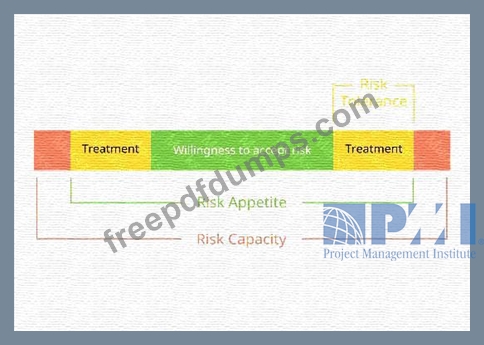
Analysis of Distractors: A. Responses: These are the specific actions determined to address threats or opportunities (e.g., Avoid, Mitigate, Transfer). Responses are the result of the risk attitude, not the reflection of the balance itself.
B). Appetite: While related, " Appetite " specifically refers to the amount of risk an entity is willing to take. " Attitude " is the broader descriptor of how the organization perceives and acts upon that balance.
* C. Tolerance: This refers to the measurable, granular levels of acceptable deviation (e.g., " We can tolerate a 5% budget overrun " ). It is a specific metric rather than a general reflection of the perceived balance between taking and avoiding risk.
Risk attitude is influenced by three primary factors:
Risk Appetite: The degree of uncertainty an organization or individual is willing to accept in anticipation of a reward.
* Risk Tolerance: The specified range of acceptable variation around an objective.
* Risk Threshold: The level of risk exposure above which risks are addressed and below which risks may be accepted.
The PMBOKGuide notes that the project team must understand the risk attitude of the organization and stakeholders to ensure that the Risk Management Plan aligns with the corporate culture.
Analysis of Distractors: A. Responses: These are the specific actions determined to address threats or opportunities (e.g., Avoid, Mitigate, Transfer). Responses are the result of the risk attitude, not the reflection of the balance itself.
B). Appetite: While related, " Appetite " specifically refers to the amount of risk an entity is willing to take. " Attitude " is the broader descriptor of how the organization perceives and acts upon that balance.
* C. Tolerance: This refers to the measurable, granular levels of acceptable deviation (e.g., " We can tolerate a 5% budget overrun " ). It is a specific metric rather than a general reflection of the perceived balance between taking and avoiding risk.
- Other Version
- 2889PMI.CAPM.v2026-09-05.q632
- 4980PMI.CAPM.v2026-07-17.q643
- 5553PMI.CAPM.v2023-02-14.q281
- 12167PMI.CAPM.v2022-05-24.q570
- 59PMI.Pass4guide.CAPM.v2022-05-12.by.shirley.570q.pdf
- 15050PMI.CAPM.v2022-01-02.q768
- 89PMI.Exams4sures.CAPM.v2021-08-25.by.odelette.722q.pdf
- Latest Upload
- 123Fortinet.NSE5_FSW_AD-7.6.v2026-10-20.q51
- 110EC-COUNCIL.212-89.v2026-10-20.q204
- 111EC-COUNCIL.312-50.v2026-10-20.q421
- 161Oracle.1Z0-931-26.v2026-10-19.q61
- 158Microsoft.AI-200.v2026-10-19.q43
- 140Oracle.1z0-1195-26.v2026-10-19.q23
- 289Microsoft.MS-102.v2026-10-19.q259
- 313ECCouncil.312-50v13.v2026-10-19.q453
- 207Oracle.1Z0-1110-26.v2026-10-17.q71
- 271CloudSecurityAlliance.CCSK.v2026-10-17.q153