An engineer configures User-ID redistribution from an on-premises firewall connected to Prisma Access (Managed by Panorama) using a service connection. After committing the configuration, traffic from remote network connections is still not matching the correct user-based policies. Which two configurations need to be validated? (Choose two.)
Correct Answer: C,D
Because the on-premises firewall is redistributing User-ID information into Prisma Access over the service connection, the redistribution agent object must be configured within the template that actually governs the service connection ' s dataplane - the Service_Conn_Template - not the Remote_Network_Template, which applies to a different set of nodes entirely and would leave the redistribution agent unreachable from the path the data is actually traversing. Selecting the wrong template is a common and easily overlooked misconfiguration that silently prevents the mapping information from being ingested at all, which is why validating the Service_Conn_Template assignment (option D) is essential. Equally important is the Collector Pre-Shared Key: User-ID redistribution uses this shared secret to authenticate the connection between the redistributing firewall and the receiving collector, and any mismatch between the value configured on the on- premises firewall and the value configured in Prisma Access will cause the redistribution session to fail silently or be rejected, leaving remote network traffic unmapped even though the configuration otherwise looks complete - this is option C. Option A names the wrong template for a service-connection-sourced redistribution scenario, so it does not apply here. Option B, while port 5007 is indeed the standard User-ID redistribution port, describes a downstream security policy check that is secondary to first confirming the agent is bound to the correct template and authenticated correctly; a PSK mismatch or wrong template assignment will prevent the session regardless of policy. Reference:Prisma Access - User-ID Redistribution from On-Premises Firewalls via Service Connection.
SSE-Engineer Exam Question 2
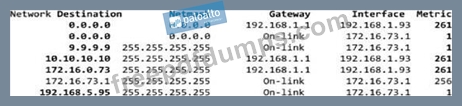
An engineer is troubleshooting split-tunneling on a Palo Alto Networks VPN client. The local LAN interface is on the 192.168.1.0/24 network, and the Prisma Access Mobile User IP Pool is configured as 172.16.72.0/23 in Strata Cloud Manager (SCM). Based on the image below, which statement regarding the split-tunneling configuration for the VPN client is valid?
Correct Answer: A
Interpreting a client-side split-tunnel routing table requires distinguishing three categories of entries: the broad, tunnel-wide default or pool-derived routes automatically installed by the GlobalProtect connection itself, host routes that fall naturally within the local LAN subnet and therefore route locally regardless of tunnel configuration, and host routes that fall entirely outside both the local LAN subnet (192.168.1.0/24) and the mobile user IP pool (172.16.72.0/23) - the latter category is the tell-tale signature of a deliberately, explicitly configured split-tunnel include route, since GlobalProtect would have no other reason to install a specific /32 host route for an address that belongs to neither the local network nor the assigned tunnel pool unless an administrator had explicitly added it as an include access route. A host address such as 9.9.9.9/32 falls squarely outside both of those ranges, so its presence as a specific /32 entry pointing into the tunnel interface is explained only by an explicit administrator-configured include route, which is exactly the conclusion in option A. By contrast, an address like 192.168.5.95 sits inside the broader local LAN addressing scheme referenced in the scenario and would be explained by local network routing behavior rather than a deliberate tunnel exclude configuration, and an address like 172.16.73.1 falls within the 172.16.72.0/23 mobile user pool itself, meaning its routing behavior is already accounted for by the pool ' s own default tunnel-inclusion behavior rather than representing a distinct, explicitly configured exclude entry. Reference:GlobalProtect - Split Tunnel Access Route Verification via Client Routing Table.
SSE-Engineer Exam Question 3
Which two Prisma Access Browser (PAB) configurations will provide a contractor SSH access to an internal system? (Choose two.)
Correct Answer: B,C
SSH is fundamentally different from a standard HTTP/HTTPS-based internal web application, since it is a non-web, terminal-based protocol, and PAB accommodates protocols like SSH and RDP through a distinct capability generally referred to as Remote Connections rather than the standard internal web application publishing workflow. Enabling Remote Connections is the prerequisite platform capability that allows PAB to broker non-web protocol sessions such as SSH at all, making option B a necessary first configuration step. Once that capability is enabled, the administrator must define the actual target system as a Remote Connection Application entry - specifying the internal host, port, and protocol (SSH in this case) the contractor needs to reach - and then build an Access & Data Control policy that authorizes the specific contractor or contractor group to reach that defined Remote Connection application entry, which is exactly what option C describes and is the configuration pairing that actually grants and governs the access. Option A describes " Internal Application entries " rather than " Remote Connection Application entries " - internal (web) application entries are the construct used for standard HTTP/HTTPS internal application publishing, not SSH, so this pairing misapplies the wrong application object type to a non-web protocol use case. Option D references " Internal Connections " as a toggle, which is not the correctly named capability for enabling non-web protocol brokering in PAB; the documented feature and terminology for SSH/RDP-style access is Remote Connections, not " Internal Connections. " Reference:Prisma Access Browser - Remote Connections for SSH/RDP Access to Internal Systems.
SSE-Engineer Exam Question 4
A malicious user is attempting to connect to a blocked website by crafting a packet using a fake SNI and the correct website in the HTTP host header. Which option will prevent this form of attack?
Correct Answer: D
Domain fronting works by presenting a benign or allowed hostname in the TLS ClientHello SNI field while the actual intended destination is embedded in the encrypted HTTP Host header, exploiting the fact that many security controls historically made policy decisions based on the SNI alone, before decryption exposed the true host being requested. The correct defense operates at the SSL Decryption layer itself: when Prisma Access decrypts the session, it can compare the SNI presented during the handshake against the Subject Alternative Name/Common Name actually returned in the server ' s certificate, and the " Block sessions on SNI mismatch with Server Certificate (SAN/CN) " decryption profile setting will terminate any session where these values do not agree - which is exactly the signature of a domain-fronting attempt, since the fake SNI will not match the certificate genuinely presented by the real destination server. This makes option D the correct, purpose-built control. There is no " Domain Fronting " toggle within Advanced Threat Prevention (option A); ATP focuses on exploit and vulnerability signatures, not SNI/certificate correlation. Advanced URL Filtering ' s " Malicious Behavior " category (option B) is a URL reputation classification and does not perform SNI-versus-certificate comparison. Option C names a setting that does not exist as an Advanced URL Filtering control; SNI-mismatch detection and enforcement is a decryption-profile capability, not a URL filtering category action, which is the key distinction separating the correct answer from this distractor. Reference:PAN-OS Decryption Profiles - Block Sessions with SNI Mismatch (SAN/CN) as a Domain Fronting Defense.
SSE-Engineer Exam Question 5
What is the network impact when a Prisma Access service connection is set as a dedicated service connection for traffic steering?
Correct Answer: B
When a service connection is designated as a dedicated connection specifically for traffic steering - meaning it is repurposed to carry internet-bound traffic out through a customer ' s own data center internet edge rather than functioning as an ordinary path to internal, trusted data center resources - its role in the security architecture fundamentally changes from an internal, trusted path to an internet egress path, and Prisma Access reflects that change by reclassifying its zone from Trust to Untrust. Because the traffic steered through this connection is destined for the internet rather than for internal resources reachable via dynamic routing, the dedicated connection applies source NAT to the forwarded traffic (translating it to an address appropriate for internet egress at the customer ' s edge) and stops participating in the internal BGP routing exchange that governs reachability to genuinely private, internal data center subnets - behavior that would be inappropriate for a connection now functioning as an internet breakout path. This combination of zone reclassification to Untrust, source NAT application, and BGP non-participation is exactly what option B describes. Option A incorrectly asserts the zone remains Trust and BGP participation continues unchanged, which does not reflect the reclassification that occurs. Option C incorrectly claims Security policies are disabled entirely, which would represent an unacceptable and undocumented security posture. Option D describes destination NAT and continued BGP participation, which misattributes the NAT direction and routing behavior actually associated with a dedicated traffic-steering service connection. Reference:Prisma Access - Traffic Steering and Dedicated Service Connection Zone/NAT Behavior.