Explanation The true statement related to PEP 257 is Option B. According to PEP 257, string literals occurring elsewhere in Python code may also act as documentation. They are not recognized by the Python bytecode compiler and are not accessible as runtime object attributes (i.e. not assigned to doc), but two types of extra docstrings may be extracted by software tools: String literals occurring immediately after a simple assignment at the top level of a module, class, or init method are called "attribute docstrings". String literals occurring immediately after another docstring are called "additional docstrings"1.
PCPP-32-101 Exam Question 17
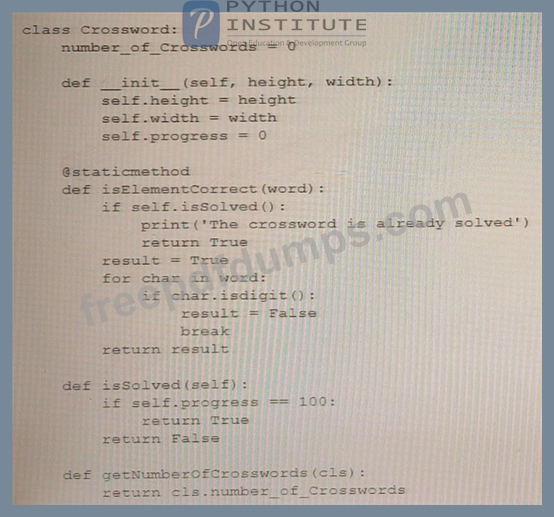
Analyze the following snippet and decide whether the code is correct and/or which method should be distinguished as a class method.
Correct Answer: B
Explanation The correct answer is B. The getNumberofCrosswords() method should be decorated with @classmethod. In the given code snippet, the getNumberofCrosswords method is intended to be a class method that returns the value of the numberofcrosswords class variable. However, the method is not decorated with the @classmethod decorator and does not take a cls parameter representing the class itself. To make getNumberofCrosswords a proper class method, it should be decorated with @classmethod and take a cls parameter as its first argument. The getNumberofCrosswords() method should be decorated with @classmethod. This is because the getNumberofCrosswords() method is intended to access the class-level variable numberofcrosswords, but it is defined as an instance method, which requires an instance of the class to be created before it can be called. To make it work as a class-level method, you can define it as a class method by adding the @classmethod decorator to the function. Here's an example of how to define getNumberofCrosswords() as a class method: classCrossword: numberofcrosswords =0 def __init__(self, author, title): self.author = author self.title = title Crossword.numberofcrosswords +=1 @classmethod defgetNumberofCrosswords(cls): returncls.numberofcrosswords In this example, getNumberofCrosswords() is defined as a class method using the @classmethod decorator, and the cls parameter is used to access the class-level variable numberofcrosswords.
PCPP-32-101 Exam Question 18
Select the true statements about the sqlite3 module. (Select two answers.)
Correct Answer: C,D
Explanation The execute method is provided by the Cursor class This statement is true because the execute method is one of the methods of the Cursor class in the sqlite3 module. The Cursor class represents an object that can execute SQL statements and fetch results from a database connection. The execute method takes an SQL query as an argument and executes it against the database. For example, cur = conn.cursor (); cur.execute ("SELECT * FROM table") creates and executes a cursor object that selects all rows from a table. The fetchone method returns None when no rows are available This statement is true because the fetchone method is another method of the Cursor class in the sqlite3 module. The fetchone method fetches the next row of a query result set and returns it as a single tuple or None if no more rows are available. For example, row = cur.fetchone () fetches and returns one row from the cursor object or None if there are no more rows.
PCPP-32-101 Exam Question 19
What does the term deserialization mean? Select the best answer.
Correct Answer: A
Explanation answer A. Deserialization is the process of converting data that has been serialized or encoded in a specific format, back into its original form as an object or a data structure in memory. In Python, this typically involves creating Python objects based on sequences of bytes that have been serialized using a protocol such as JSON, Pickle, or YAML. For example, if you have a Python object my_obj and you want to serialize it to a JSON string, you might do something like this: importjson serialized_obj = json.dumps(my_obj) To deserialize the JSON string back into a Python object, you would use the json.loads() method: deserialized_obj = json.loads(serialized_obj) This would convert the JSON string back into its original Python object form.
PCPP-32-101 Exam Question 20
Select the true statement about the___name___attribute.
Correct Answer: D
Explanation The true statement about the __name__ attribute is D. name is a special attribute, which is inherent for classes, and it contains the name of a class. The __name__ attribute is a special attribute of classes that contains the name of the class as a string. The __name__ attribute is a special attribute in Python that is available for all classes, and it contains the name of the class as a string. The __name__ attribute can be accessed from both the class and its instances using the dot notation.