Which of the following is a strategy for reducing indoor water use?
Correct Answer: B
Using graywater for hand washing is a strategy for reducing indoor water use, as it can save potable water that would otherwise be used for this purpose. Graywater is the wastewater that is generated from activities such as bathing, laundry, and dishwashing, which can be treated and reused for non-potable applications, such as toilet flushing, irrigation, and hand washing. Using graywater for hand washing can reduce the indoor water use by up to 40%, according to a study by the Pacific Institute1. LEED v4 recognizes and rewards this strategy in the Indoor Water Use Reduction credit2, which aims to reduce the potable water consumption of a building by at least 25% compared to a baseline3. The other options are not directly related to reducing indoor water use, as they involve different types of measures or systems that are not relevant for saving potable water.
LEED-Green-Associate Exam Question 117
What are the values and benefits of building green?
Correct Answer: C
One of the values and benefits of building green is that it will enhance the health of the building occupants. Building green is a process that incorporates environmental considerations into every stage of a building's life cycle, from design to construction to operation to end-of-life. Building green can improve the indoor environmental quality (IEQ) of a building, which is the physical and psychological conditions of the indoor spaces that affect the health, comfort, and productivity of the occupants. Building green can enhance IEQ by using low-emitting materials, providing adequate ventilation, controlling temperature and humidity, optimizing daylighting and lighting quality, reducing noise levels, and promoting occupant well- being12. References: LEED v4 Green Associate Candidate Handbook1, LEED v4 BD+C Reference Guide2
LEED-Green-Associate Exam Question 118
A building manager is comparing the operating cost of the existing boiler to the purchase and operation of a new and more efficient boiler. The building manager discovers that although the upfront cost is significant, purchasing the new boiler would drastically decrease the cost of running and operating the system. This exercise is called
Correct Answer: A
Life-cycle costing is an economic analysis method that considers all costs associated with an asset over its entire life cycle, from acquisition and installation to operation, maintenance, and disposal. In this case, the building manager is comparing the total costs of owning and operating two different boilers over their respective lifetimes. References: LEED Green Associate Candidate Handbook, U.S. Green Building Council resources
LEED-Green-Associate Exam Question 119
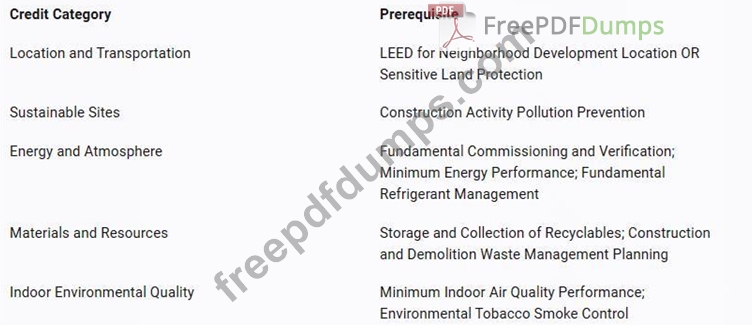
Which of the following credit categories does not have a prerequisite?
Correct Answer: A
Water Efficiency is the only credit category that does not have a prerequisite in LEED v4 for Building Design and Construction. Prerequisites are the minimum requirements that all projects must meet to be eligible for LEED certification. They are mandatory and non-weighted, meaning they do not contribute to the project's score. The other credit categories have at least one prerequisite each, as shown in the table below: References: LEED v4 Reference Guide for Building Design and Construction, p. 17 1; [LEED v4 BD+C Scorecard]
LEED-Green-Associate Exam Question 120
Which of the following components comprise the Indoor Environmental Quality credit category?
Correct Answer: B
Light, sound, occupant experience are some of the components that comprise the Indoor Environmental Quality credit category. The Indoor Environmental Quality credit category aims to provide a healthy, comfortable, and productive indoor environment for building occupants by addressing various factors that affect their well-being, such as thermal comfort, lighting quality, acoustic quality, air quality, and occupant control. The LEED Green Associate Candidate Handbook states that one of the intents of the Indoor Environmental Quality category is to "enhance indoor environmental quality (IEQ) by improving the design, construction and operation of buildings" [1, p. 16]. References: LEED Green Associate Candidate Handbook, [Indoor Environmental Quality | U.S. Green Building Council]
Newest LEED-Green-Associate Exam PDF Dumps shared by Actual4test.com for Helping Passing LEED-Green-Associate Exam! Actual4test.com now offer the updated LEED-Green-Associate exam dumps, the Actual4test.com LEED-Green-Associate exam questions have been updated and answers have been corrected get the latest Actual4test.com LEED-Green-Associate pdf dumps with Exam Engine here: