
- Home
- APMG-International
- AgilePM-Practitioner
- APMG-International.AgilePM-Practitioner.v2026-07-04.q78 Practice Test (Page 10)

AgilePM-Practitioner Exam Question 41
Most of the Customer Services staff are working with the new processes. However, there are a number of remaining staff who don't want to be trained in the new technologies and wish to continue supporting the old business areas.
Which is the MOST appropriate intervention from the Customer Service Director?
Which is the MOST appropriate intervention from the Customer Service Director?
Correct Answer: B
Comprehensive and Detailed Step-by-Step Explanation:
Context from the UniCo Scenario:
The Customer Services staff are grappling with resistance to new technologies and processes due to discomfort or attachment to older methods. The Customer Services Director must intervene in a manner that minimizes resistance, builds trust, and encourages adoption of the changes. Understanding the root cause of the resistance is key to managing and addressing it effectively.
Analysis of Each Option:
* A. Identify workarounds for those staff who resist the new processes so that they can remain operating within the new structure.
* Why Incorrect:While workarounds may provide short-term relief, they compromise the change initiative by creating inconsistencies and preventing full integration of the new processes. It risks undermining the strategic goals of moving to innovative solutions.
* B. Maintain a listening stance, showing interest in understanding the reasons for the discomfort that many are feeling over the changes.
* Why Correct:Maintaining a listening stance demonstrates empathy and fosters psychological safety, encouraging staff to openly share their concerns. This allows the Director to identify and address specific barriers to change. Engaging staff in this way builds trust and aligns with Agile principles of stakeholder collaboration.
* C. Shock staff into action by telling them that some staff will lose their place in the organization if they are unable to make adjustments.
* Why Incorrect:Using fear or intimidation may temporarily force compliance but is likely to backfire by increasing resistance, damaging morale, and eroding trust. It goes against AgilePM's emphasis on maintaining a supportive and collaborative environment during change.
* D. Consider leaving some of the existing structure unchanged so that those who may not find the change workable can be accommodated.
* Why Incorrect:This approach contradicts the strategic objectives of integrating Selco and transitioning to new technologies. Allowing parts of the old structure to remain undermines the long-term success and sustainability of the change initiative.
Why B Is the Best Option:
* Encourages Engagement and Trust:
* By listening to staff concerns, the Director shows respect for their opinions, fostering a culture of collaboration and inclusion. This aligns with AgilePM's principles of empowering individuals and teams to participate in the change process.
* Targets the Root Cause of Resistance:
* Resistance often stems from fear of the unknown or lack of understanding. A listening stance helps uncover these root causes, allowing tailored interventions to address them.
* Aligns with Change Management Best Practices:
* Kotter's Change Model and AgilePM both emphasize the importance of effective communication and stakeholder engagement to reduce resistance and build momentum for change.
References to AgilePM Framework:
* Stakeholder Collaboration:
* AgilePM promotes collaboration and open communication with stakeholders to address concerns and ensure their involvement in the change process. (AgilePM Practitioner Guide, Chapter 8:
Stakeholder Engagement)
* Empathy in Leadership:
* Effective change leaders understand and address the emotional and practical concerns of their teams. Maintaining a listening stance is a key behavior outlined in change management best practices. (AgilePM Practitioner Guide, Chapter 9: Empowering Teams)
Context from the UniCo Scenario:
The Customer Services staff are grappling with resistance to new technologies and processes due to discomfort or attachment to older methods. The Customer Services Director must intervene in a manner that minimizes resistance, builds trust, and encourages adoption of the changes. Understanding the root cause of the resistance is key to managing and addressing it effectively.
Analysis of Each Option:
* A. Identify workarounds for those staff who resist the new processes so that they can remain operating within the new structure.
* Why Incorrect:While workarounds may provide short-term relief, they compromise the change initiative by creating inconsistencies and preventing full integration of the new processes. It risks undermining the strategic goals of moving to innovative solutions.
* B. Maintain a listening stance, showing interest in understanding the reasons for the discomfort that many are feeling over the changes.
* Why Correct:Maintaining a listening stance demonstrates empathy and fosters psychological safety, encouraging staff to openly share their concerns. This allows the Director to identify and address specific barriers to change. Engaging staff in this way builds trust and aligns with Agile principles of stakeholder collaboration.
* C. Shock staff into action by telling them that some staff will lose their place in the organization if they are unable to make adjustments.
* Why Incorrect:Using fear or intimidation may temporarily force compliance but is likely to backfire by increasing resistance, damaging morale, and eroding trust. It goes against AgilePM's emphasis on maintaining a supportive and collaborative environment during change.
* D. Consider leaving some of the existing structure unchanged so that those who may not find the change workable can be accommodated.
* Why Incorrect:This approach contradicts the strategic objectives of integrating Selco and transitioning to new technologies. Allowing parts of the old structure to remain undermines the long-term success and sustainability of the change initiative.
Why B Is the Best Option:
* Encourages Engagement and Trust:
* By listening to staff concerns, the Director shows respect for their opinions, fostering a culture of collaboration and inclusion. This aligns with AgilePM's principles of empowering individuals and teams to participate in the change process.
* Targets the Root Cause of Resistance:
* Resistance often stems from fear of the unknown or lack of understanding. A listening stance helps uncover these root causes, allowing tailored interventions to address them.
* Aligns with Change Management Best Practices:
* Kotter's Change Model and AgilePM both emphasize the importance of effective communication and stakeholder engagement to reduce resistance and build momentum for change.
References to AgilePM Framework:
* Stakeholder Collaboration:
* AgilePM promotes collaboration and open communication with stakeholders to address concerns and ensure their involvement in the change process. (AgilePM Practitioner Guide, Chapter 8:
Stakeholder Engagement)
* Empathy in Leadership:
* Effective change leaders understand and address the emotional and practical concerns of their teams. Maintaining a listening stance is a key behavior outlined in change management best practices. (AgilePM Practitioner Guide, Chapter 9: Empowering Teams)
AgilePM-Practitioner Exam Question 42
(At the Sprint Review for Sprint 3, it became clear that the Spa infrastructure will not support hydrotherapy treatments. The equipment is unable to chill the plunge pool, making these treatments ineffective.
Demonstrating Agile Leadership and Collaboration, what action should have taken place during the Project Sprint Planning Event to prevent this?)
Demonstrating Agile Leadership and Collaboration, what action should have taken place during the Project Sprint Planning Event to prevent this?)
Correct Answer: F
The correct answer is F .
This issue happened because there was a failure of cross-team alignment between business intent and technical implementation . The treatments being developed required a specific infrastructure capability, but that dependency was not properly translated into prioritized, shared understanding during planning.
In AgilePM, the most effective way to prevent this is through active collaboration between the business
/value role and the solution/technical role . That is exactly what option F describes.
Why F is correct:
* Mira Bachar represents the business need and delivery priorities.
* Sukra Aroon ensures solution integrity and technical feasibility.
* Hydrotherapy is not just a treatment idea; it has infrastructure implications .
* Therefore, during Sprint Planning, they should have worked together to make sure those requirements were:
* understood,
* prioritized,
* communicated clearly,
* and reflected in the work of the Infrastructure Team.
This is a strong AgilePM answer because it combines:
* Agile leadership through collaboration rather than command-and-control,
* practical coordination across dependent work,
* and shared responsibility for making sure business goals are technically supported.
In this case, the plunge pool chilling capability was a critical enabling requirement. If Sukra and Mira had aligned early, the infrastructure team would have known that hydrotherapy capability was not optional or implicit, but a necessary requirement for the increment to deliver its intended value.
Why the other options are not the best answer:
A). Mira Bachar and Lee Tan should have worked together to integrate stakeholder feedback into the Product Backlogs before the next Sprint.
This is not the best answer because the issue was not mainly stakeholder feedback. It was a missed dependency between treatment design and infrastructure capability.
B). Mira Bachar should have amended the Product Backlogs to include explicit hydrotherapy infrastructure requirements for both Delivery Teams.
This is partly useful, but too one-sided. Mira alone should not be expected to define technically specific infrastructure requirements without collaboration from Sukra. AgilePM encourages joint work between business and technical roles.
C). Hira should have ensured transparency of the Delivery Plan so each Delivery Team could plan the remainder of their Sprints accordingly.
Transparency helps, but this would not by itself guarantee that the chilling requirement was recognized and built into the infrastructure solution.
D). Hira should have worked with Sukra Aroon to adjust project timelines to give flexibility to the Infrastructure Team and Treatments Teams before the next Sprint.
This is reactive and schedule-focused. The real problem was not insufficient time; it was missing alignment on a critical requirement.
E). Sukra Aroon should have documented hydrotherapy infrastructure requirements in the Solution Architecture Definition so the two Delivery Teams were aligned.
Documentation may help, but this is too document-centric for the best AgilePM answer. AgilePM prefers collaborative communication and shared understanding over relying primarily on formal documents.
G). Brinda Vyas and Hira should have ensured hydrotherapy treatments were align with business strategy.
Business strategy alignment is important, but it does not address the specific technical dependency that caused the failure.
H). Brinda Vyas should have worked with the Treatments Team to ensure hydrotherapy-related treatments are feasible within constraints.
This is not the best role fit. Feasibility is primarily a technical and solution concern, supported by the Solution Architect, not mainly the Business Visionary.
AgilePM perspective:
This question is about preventing integration failure across two Delivery Teams. AgilePM would favor:
* early identification of dependencies,
* collaboration between business and technical roles,
* clear communication of enabling requirements,
* and planning based on shared understanding of what is needed to deliver business value.
Hydrotherapy treatments only create value if the supporting infrastructure can actually enable them. So the business priority and the technical solution had to be connected during planning.
Therefore, the best AgilePM answer is F .
This issue happened because there was a failure of cross-team alignment between business intent and technical implementation . The treatments being developed required a specific infrastructure capability, but that dependency was not properly translated into prioritized, shared understanding during planning.
In AgilePM, the most effective way to prevent this is through active collaboration between the business
/value role and the solution/technical role . That is exactly what option F describes.
Why F is correct:
* Mira Bachar represents the business need and delivery priorities.
* Sukra Aroon ensures solution integrity and technical feasibility.
* Hydrotherapy is not just a treatment idea; it has infrastructure implications .
* Therefore, during Sprint Planning, they should have worked together to make sure those requirements were:
* understood,
* prioritized,
* communicated clearly,
* and reflected in the work of the Infrastructure Team.
This is a strong AgilePM answer because it combines:
* Agile leadership through collaboration rather than command-and-control,
* practical coordination across dependent work,
* and shared responsibility for making sure business goals are technically supported.
In this case, the plunge pool chilling capability was a critical enabling requirement. If Sukra and Mira had aligned early, the infrastructure team would have known that hydrotherapy capability was not optional or implicit, but a necessary requirement for the increment to deliver its intended value.
Why the other options are not the best answer:
A). Mira Bachar and Lee Tan should have worked together to integrate stakeholder feedback into the Product Backlogs before the next Sprint.
This is not the best answer because the issue was not mainly stakeholder feedback. It was a missed dependency between treatment design and infrastructure capability.
B). Mira Bachar should have amended the Product Backlogs to include explicit hydrotherapy infrastructure requirements for both Delivery Teams.
This is partly useful, but too one-sided. Mira alone should not be expected to define technically specific infrastructure requirements without collaboration from Sukra. AgilePM encourages joint work between business and technical roles.
C). Hira should have ensured transparency of the Delivery Plan so each Delivery Team could plan the remainder of their Sprints accordingly.
Transparency helps, but this would not by itself guarantee that the chilling requirement was recognized and built into the infrastructure solution.
D). Hira should have worked with Sukra Aroon to adjust project timelines to give flexibility to the Infrastructure Team and Treatments Teams before the next Sprint.
This is reactive and schedule-focused. The real problem was not insufficient time; it was missing alignment on a critical requirement.
E). Sukra Aroon should have documented hydrotherapy infrastructure requirements in the Solution Architecture Definition so the two Delivery Teams were aligned.
Documentation may help, but this is too document-centric for the best AgilePM answer. AgilePM prefers collaborative communication and shared understanding over relying primarily on formal documents.
G). Brinda Vyas and Hira should have ensured hydrotherapy treatments were align with business strategy.
Business strategy alignment is important, but it does not address the specific technical dependency that caused the failure.
H). Brinda Vyas should have worked with the Treatments Team to ensure hydrotherapy-related treatments are feasible within constraints.
This is not the best role fit. Feasibility is primarily a technical and solution concern, supported by the Solution Architect, not mainly the Business Visionary.
AgilePM perspective:
This question is about preventing integration failure across two Delivery Teams. AgilePM would favor:
* early identification of dependencies,
* collaboration between business and technical roles,
* clear communication of enabling requirements,
* and planning based on shared understanding of what is needed to deliver business value.
Hydrotherapy treatments only create value if the supporting infrastructure can actually enable them. So the business priority and the technical solution had to be connected during planning.
Therefore, the best AgilePM answer is F .
AgilePM-Practitioner Exam Question 43
Midway through Project Increment 4, a joint Sprint Retrospective is held with Developers from both Delivery Teams.
Some members from Marketing and IT, based in India, join via video conferencing.
Issues raised:
. Dependency management challenges
Concerns about AgilePM principle ' Demonstrate Control '
To address this, Mira Bachar and the Developers invite Hira and Sukra Aroon to help Delivery Teams understand the issues, assess the consequences, and collaborate on solutions that align with AgilePM and Scrum.
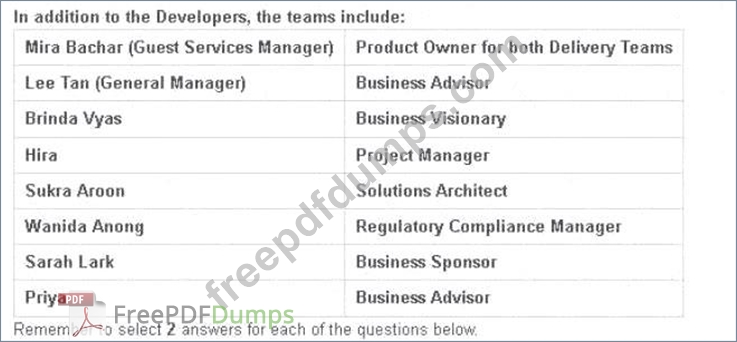
In addition to the Developers, the teams include:
(During the Sprint, Mira Bachar identified inconsistencies between what she wanted, expressed in Product Backlog items, and the Product Increments delivered by the Delivery Teams.
Which 2 of the following would be appropriate actions for Mira to take in the next Sprint?)
Some members from Marketing and IT, based in India, join via video conferencing.
Issues raised:
. Dependency management challenges
Concerns about AgilePM principle ' Demonstrate Control '
To address this, Mira Bachar and the Developers invite Hira and Sukra Aroon to help Delivery Teams understand the issues, assess the consequences, and collaborate on solutions that align with AgilePM and Scrum.
In addition to the Developers, the teams include:
(During the Sprint, Mira Bachar identified inconsistencies between what she wanted, expressed in Product Backlog items, and the Product Increments delivered by the Delivery Teams.
Which 2 of the following would be appropriate actions for Mira to take in the next Sprint?)
Correct Answer: A,B
The best answers are A and B .
A is correct because AgilePM depends on active business involvement . If Mira sees a mismatch between intended outcomes and delivered increments, she should increase her availability to clarify needs, answer questions, review progress, and provide timely feedback.
B is also correct because clear acceptance criteria and practical examples reduce ambiguity and help the Delivery Teams understand what "done correctly" looks like for each Backlog item.
Why the others are weaker:
* C is too document-heavy and not aligned with AgilePM's lightweight, collaborative approach.
* D adds translation layers instead of improving direct collaboration and clarity.
* E is about estimation, not about resolving misunderstanding between need and delivered outcome.
So the correct answers are A, B .
A is correct because AgilePM depends on active business involvement . If Mira sees a mismatch between intended outcomes and delivered increments, she should increase her availability to clarify needs, answer questions, review progress, and provide timely feedback.
B is also correct because clear acceptance criteria and practical examples reduce ambiguity and help the Delivery Teams understand what "done correctly" looks like for each Backlog item.
Why the others are weaker:
* C is too document-heavy and not aligned with AgilePM's lightweight, collaborative approach.
* D adds translation layers instead of improving direct collaboration and clarity.
* E is about estimation, not about resolving misunderstanding between need and delivered outcome.
So the correct answers are A, B .
AgilePM-Practitioner Exam Question 44


Correct Answer:

Explanation:
Here the task is to identify which AgilePM principle is most significantly compromised in each case, based on the behavior or concern described.
1. Lee Tan is skeptical about agile ways of working and dismisses Sprint Reviews as a waste of time, creating tension and hindering collective alignment.
answer: G - Communicate continuously and clearly
Sprint Reviews are a core mechanism for transparency, feedback, shared understanding, and alignment. If Lee dismisses them and creates tension around them, the biggest principle being undermined is continuous and clear communication .
Why not just Collaborate ?
That is also affected, but the most direct issue here is rejection of a structured communication and feedback forum. Sprint Reviews exist to keep business and delivery aligned through ongoing communication.
So the most significantly compromised principle is:
1 # G
2. Priya insists that all aspects of the aromatherapy oil, including packaging and marketing, must be fully defined before development, causing concern among teammates.
answer: F - Develop iteratively
This directly conflicts with AgilePM's belief that not everything must be fully detailed upfront. AgilePM supports evolving detail over time through learning, feedback, and iteration.
Priya's position reflects a predictive mindset: define everything first, then build. AgilePM instead encourages starting from sufficient understanding and refining as the team learns more.
So the most significantly compromised principle is:
2 # F
3. Lee Tan is reluctant to release operational staff to act as Business Advisors for the Spa's booking system, prioritizing short term efficiencies. He assumes business requirements are obvious and Developers can proceed without direct business input.
answer: A - Focus on the business need
This is a strong violation of the principle of focusing on the business need . AgilePM depends on active business involvement to ensure that what is delivered genuinely meets operational and strategic needs.
If operational staff are not made available as Business Advisors, the team risks building a solution based on assumptions rather than real business understanding. That undermines the ability to ensure the solution is fit for business purpose.
Why not Collaborate ?
That is involved too, but the core failure is the assumption that delivery can proceed without direct business input. That most fundamentally threatens alignment to the real business need.
So the most significantly compromised principle is:
3 # A
4. Many Delivery Team members in Spa operations, marketing, and IT are part-time and their daily responsibilities are taking priority over project roles. Their limited availability raises concerns about meeting Sprint commitments.
answer: B - Deliver on time
This concern most clearly threatens the AgilePM principle of delivering on time . If part-time participation and competing priorities reduce team capacity, Sprint commitments become unreliable and timeboxes are put at risk.
AgilePM places strong emphasis on protecting time and using prioritization and commitment to ensure timely delivery. If people are not sufficiently available, timely delivery becomes difficult.
Why not Demonstrate control ?
That could also be affected, but the scenario explicitly points to concern about meeting Sprint commitments, which most directly maps to delivery timeliness.
So the most significantly compromised principle is:
4 # B
5. IT developers worry that testing critical booking system integrations can only happen at the end of the Project Increment, rather than being embedded within each iteration.
answer: D - Never compromise quality
This most directly undermines never compromise quality . AgilePM expects quality to be built in throughout delivery, not deferred until the end. Leaving critical integration testing until the end increases the risk of defects, surprises, rework, and unstable delivery outcomes.
Testing should be integrated into the iterative process so that quality is assessed continuously and problems are found early.
Why not Develop iteratively ?
Iterative development is also relevant, but the main concern here is not iteration itself. It is that quality assurance, especially critical integration testing, is being postponed. That most clearly violates the principle of protecting quality.
So the most significantly compromised principle is:
5 # D
AgilePM-Practitioner Exam Question 45
Using the information provided in the additional information, answer the following question on building a change analytics strategy.
Do the measures to be monitored by the Sales Director represent appropriate measures for assessing change readiness?
Do the measures to be monitored by the Sales Director represent appropriate measures for assessing change readiness?
Correct Answer: C
Comprehensive and Detailed Step-by-Step Explanation:
Context from the UniCo Scenario:
The Sales Director's metrics focus on assessing the readiness of the sales team to adapt to new systems, such as their confidence levels and ability to demonstrate mobile application features. This ensures that the team is prepared for the transformation UniCo is undertaking. Change readiness is often a combination of quantitative and qualitative insights, especially for understanding how prepared and skilled staff are to adopt the new processes.
Analysis of the Answer Options:
* A. No, because change readiness measures should consist of mostly quantitative measures.
* Why Incorrect:Change readiness measures are not limited to quantitative methods. Qualitative measures, such as surveys and confidence levels, are essential for evaluating readiness in transformation programs. By relying on both, the organization gets a more holistic understanding.
* B. No, because change readiness should be monitored using the change programme plan.
* Why Incorrect:The change program plan provides an overarching structure, but it is not the sole method for monitoring readiness. The Sales Director has appropriately identified new data sources and targeted measures (e.g., surveys), which are crucial for assessing readiness directly.
* C. Yes, because the Sales Director has identified measures that require new data sources.
* Why Correct:The Sales Director's plan involves surveys to gather fresh data, such as confidence levels and proficiency in new systems. These are leading indicators for change readiness and provide actionable insights into team preparedness. Using new data sources ensures the measures are tailored to the transformation objectives, making them appropriate for assessing readiness.
* D. Yes, because these metrics provide opinions collected via mostly qualitative methods.
* Why Incorrect:While qualitative methods such as surveys are used, this answer implies an over- reliance on qualitative data. Effective change readiness strategies should balance both qualitative (e.g., confidence levels) and quantitative (e.g., percentage of staff trained) insights.
Why C Is the Best Answer:
* Focus on Leading Indicators:
* The Sales Director's identified measures focus on readiness and forward-looking insights, such as proficiency and confidence, which are key aspects of preparing staff for the change.
* Incorporating New Data Sources:
* The use of surveys as new data sources ensures that the metrics are specific to the change initiative and capture real-time readiness levels, making them highly relevant.
* Alignment with AgilePM Principles:
* AgilePM emphasizes the importance of gathering real-time, actionable data to monitor progress and adapt strategies. The Sales Director's approach aligns with this principle by introducing targeted metrics for readiness.
References to AgilePM Framework:
* Change Readiness Assessment:
* AgilePM highlights the importance of continuously assessing readiness to ensure teams can adapt and contribute effectively to change programs. (AgilePM Practitioner Guide, Chapter 7:
Governance and Control)
* Combining Data Sources:
* Balancing qualitative and quantitative methods is a best practice for ensuring that readiness measures are comprehensive and actionable. (AgilePM Practitioner Guide, Chapter 11:
Measuring Success)
Context from the UniCo Scenario:
The Sales Director's metrics focus on assessing the readiness of the sales team to adapt to new systems, such as their confidence levels and ability to demonstrate mobile application features. This ensures that the team is prepared for the transformation UniCo is undertaking. Change readiness is often a combination of quantitative and qualitative insights, especially for understanding how prepared and skilled staff are to adopt the new processes.
Analysis of the Answer Options:
* A. No, because change readiness measures should consist of mostly quantitative measures.
* Why Incorrect:Change readiness measures are not limited to quantitative methods. Qualitative measures, such as surveys and confidence levels, are essential for evaluating readiness in transformation programs. By relying on both, the organization gets a more holistic understanding.
* B. No, because change readiness should be monitored using the change programme plan.
* Why Incorrect:The change program plan provides an overarching structure, but it is not the sole method for monitoring readiness. The Sales Director has appropriately identified new data sources and targeted measures (e.g., surveys), which are crucial for assessing readiness directly.
* C. Yes, because the Sales Director has identified measures that require new data sources.
* Why Correct:The Sales Director's plan involves surveys to gather fresh data, such as confidence levels and proficiency in new systems. These are leading indicators for change readiness and provide actionable insights into team preparedness. Using new data sources ensures the measures are tailored to the transformation objectives, making them appropriate for assessing readiness.
* D. Yes, because these metrics provide opinions collected via mostly qualitative methods.
* Why Incorrect:While qualitative methods such as surveys are used, this answer implies an over- reliance on qualitative data. Effective change readiness strategies should balance both qualitative (e.g., confidence levels) and quantitative (e.g., percentage of staff trained) insights.
Why C Is the Best Answer:
* Focus on Leading Indicators:
* The Sales Director's identified measures focus on readiness and forward-looking insights, such as proficiency and confidence, which are key aspects of preparing staff for the change.
* Incorporating New Data Sources:
* The use of surveys as new data sources ensures that the metrics are specific to the change initiative and capture real-time readiness levels, making them highly relevant.
* Alignment with AgilePM Principles:
* AgilePM emphasizes the importance of gathering real-time, actionable data to monitor progress and adapt strategies. The Sales Director's approach aligns with this principle by introducing targeted metrics for readiness.
References to AgilePM Framework:
* Change Readiness Assessment:
* AgilePM highlights the importance of continuously assessing readiness to ensure teams can adapt and contribute effectively to change programs. (AgilePM Practitioner Guide, Chapter 7:
Governance and Control)
* Combining Data Sources:
* Balancing qualitative and quantitative methods is a best practice for ensuring that readiness measures are comprehensive and actionable. (AgilePM Practitioner Guide, Chapter 11:
Measuring Success)
- Latest Upload
- 166ECCouncil.312-97.v2026-10-02.q65
- 184Salesforce.Plat-UX-102.v2026-10-02.q74
- 288Microsoft.AZ-802.v2026-10-02.q206
- 173InsuranceLicensing.PA-Title-Insurance-Agent.v2026-09-30.q30
- 207EMC.NCP-MCI.v2026-09-30.q46
- 242Microsoft.GH-200.v2026-09-29.q65
- 288PECB.ISO-9001-Lead-Auditor.v2026-09-29.q115
- 239Oracle.1Z0-1080-26.v2026-09-29.q59
- 234Microsoft.GH-500.v2026-09-29.q56
- 282Splunk.SPLK-1003.v2026-09-29.q96
[×]
Download PDF File
Enter your email address to download APMG-International.AgilePM-Practitioner.v2026-07-04.q78 Practice Test