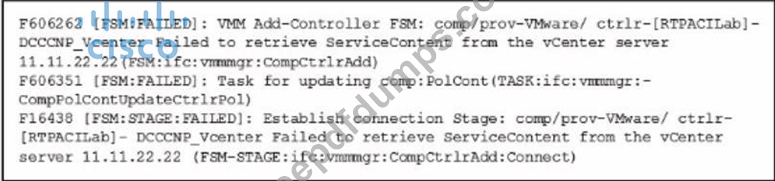
Refer to the exhibit. An engineer is configuring a VMM domain integration, but the operation fails to complete. Which two actions resolve the issue? (Choose two.)
Correct Answer: D,E
Cisco troubleshooting logic supports Change VMware vCenter IP address as the required fix. In this question the symptoms point to ACI, VMM, and the defect is best handled by correcting the exact control-plane or consistency condition. Nexus platforms can show interfaces or peers as configured while still refusing to forward traffic if a vPC Type-1 parameter, VLAN allowance, MTU, HSRP version, EVPN route, or routing attribute is wrong. Cisco methodology is to avoid broad resets unless the state machine is stuck; instead, correct the mismatched parameter and verify that the resulting operational state becomes stable. The other choices do not remove the root cause, or they modify a setting that is not used by the failing protocol exchange. After the change, the engineer should review the peer status, route or MAC table, and counters for drops or inconsistency messages. That sequence proves that the network fabric is fixed, not merely restarted.
300-615 Exam Question 77
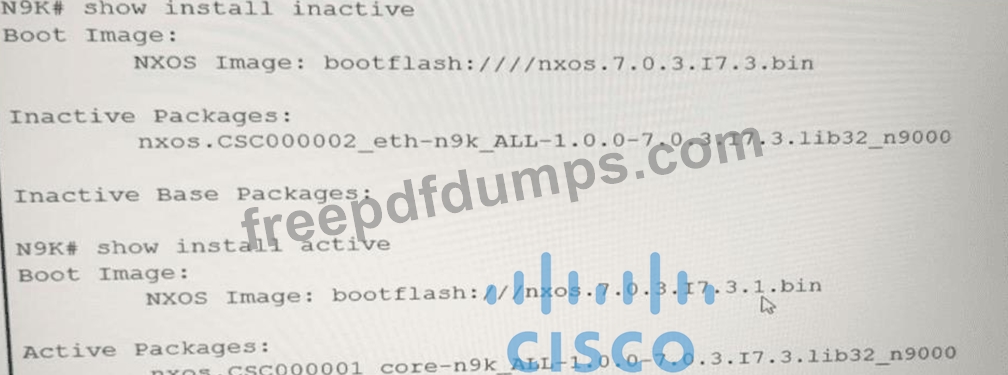
Refer to the exhibit. After an unexpected reload of the Cisco Nexus 9000 Series Switch, the network administrator noticed that one of the Software Maintenance Upgrades (SMU) images is inactive. The engineer must ensure that the package remains active after the switch is reloaded in the future. Which action accomplishes this goal?
Correct Answer: A
Commit the package using the install commit command is the valid corrective action because the failure described is a protocol or fabric state problem, not a generic connectivity issue. For Cisco Nexus, Nexus 9000, Cisco Nexus 9000, Cisco troubleshooting expects the engineer to compare both endpoints of the relationship: vPC peers must agree on consistency parameters, HSRP peers must exchange hellos in the same VLAN and version context, OSPF/BGP peers must match the attributes required for stable adjacency, and VXLAN EVPN must advertise the correct host or prefix information. The selected option restores that required state. The other options either operate on the wrong layer, change a value that is not used to form the relationship, or would make the peer relationship less deterministic. A clean validation is to inspect the control-plane table first, then verify the forwarding table, and finally test end-to-end traffic. This is the Cisco- preferred approach because it avoids random changes and confirms that the fabric is forwarding based on correct protocol state.
300-615 Exam Question 78
Refer to the exhibit The EEM applet must generate a syslog message whena BGP adjacency flaps. This message must be displayed to the console of the switch. However, when a BGP adjacency failure is simulated, no syslog message is displayed. Which action resolves the issue?
Correct Answer: D
The correct answer is Set the logging priority to Wamings. Cisco NX-OS automation features are context- sensitive: Guest Shell, Bash, EEM, scheduler, NX-API, REST calls, and Python scripts each run with their own parser, privilege model, environment, and resource limits. The scenario involves BGP, EEM, SNMP, and the selected action corrects the missing execution condition. Cisco documentation for Nexus programmability states that Guest Shell resources and networking must be configured inside the Guest Shell context, EEM applets require a valid event statement and event-default when the intercepted CLI command must continue, and API calls must target the correct managed object or class. The alternative answers either operate in the wrong context, omit a required trigger/action, or correct a parameter unrelated to the failure. Validation should include running the command manually in the same context, checking logs or return codes, and confirming that the automation completes without blocking the normal NX-OS operation it observes.
300-615 Exam Question 79
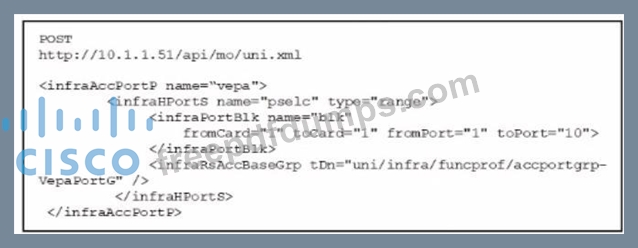
Refer to the exhibit. An engineer uses a REST API to map the interface selector with ports 1/1 to 1/20 to an interface profile. The script fails with a 400 response status code. Which action resolves the problem?
Correct Answer: D
Run the script again with valid authentication values is the required fix because the automation failure is caused by execution context, syntax, or resource state around REST API. On Cisco Nexus switches, automation is not a single feature; EEM policies, CLI actions, Guest Shell Linux commands, REST payloads, and scheduled jobs are evaluated by different subsystems. A script can fail even while the switch itself has connectivity or the command works interactively. The selected answer supplies the missing requirement, such as the correct event/action, DNS or resource setting, API URI, payload format, feature enablement, or reboot needed for a Guest Shell change to take effect. The other choices address adjacent features but do not satisfy the failing subsystem. After applying the fix, the engineer should verify the policy registration, job result, API response code, or Guest Shell runtime state and confirm that the intended command is no longer blocked or silently ignored.
300-615 Exam Question 80
You have an ACI environment with three APICs, two spine switches, and four-leaf switches. You wipe and reboot all APICs first then leaf and spine switches one-by-one and successfully go through the Initial Setup dialogue on the APIC 1 CIMC KVM console. When you log in to the APIC1 WebGUI, you notice that you do not see any directly connected leaf switches being discovered under Fabric > Inventory > Fabric Membership. What is the cause of the issue?
Correct Answer: A
The leaf nodes were not erased properly, which caused a fabric parameters mismatch with the APIC1 is correct because the failure is tied to the UCS managed state of ACI, APIC, CIMC. In Cisco UCS, policies are not advisory; they are the source from which fabric interconnects program adapters, boot targets, server identity, firmware, and external integrations. A mismatch between the policy and the actual hardware or upstream storage/network state can cause boot, discovery, KVM, firmware, or connectivity failures. The selected action addresses the object that UCS Manager uses to build the final operational configuration. The distractors either solve a different fault domain or bypass the policy model. A disciplined DCIT validation sequence is to check the fault code, the FSM history, the equipment inventory, the service profile association, and the relevant adapter or boot table. If those states are correct after the change, the UCS component should return to operable service without unnecessary reconfiguration.