

AZ-500 Exam Question 36
You have an Azure Active Directory (Azure AD) tenant that contains the users shown in the following table.
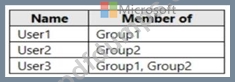
From Azure AD Privileged Identity Management (PIM), you configure the settings for the Security Administrator role as shown in the following exhibit.
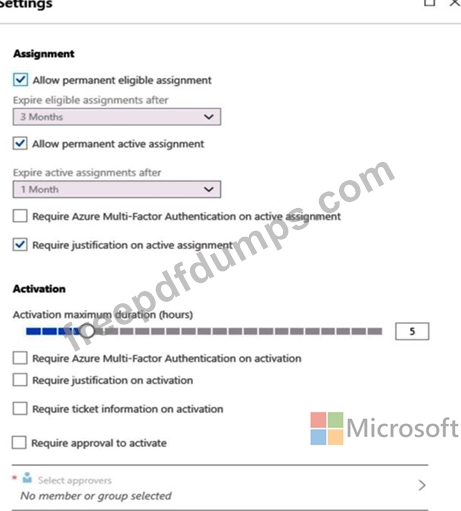
From PIM, you assign the Security Administrator role to the following groups:
Group1: Active assignment type, permanently assigned
Group2: Eligible assignment type, permanently eligible
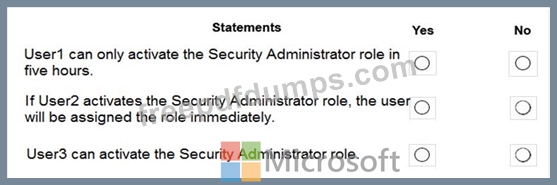
For each of the following statements, select Yes if the statement is true. Otherwise, select No.
NOTE: Each correct selection is worth one point.
From Azure AD Privileged Identity Management (PIM), you configure the settings for the Security Administrator role as shown in the following exhibit.
From PIM, you assign the Security Administrator role to the following groups:
Group1: Active assignment type, permanently assigned
Group2: Eligible assignment type, permanently eligible
For each of the following statements, select Yes if the statement is true. Otherwise, select No.
NOTE: Each correct selection is worth one point.

AZ-500 Exam Question 37
You have an Azure Active Directory (Azure AD) tenant named contoso.com that contains three security groups named Group1, Group2, and Group3 and the users shown in the following table.

Group3 is a member of Group2.
In contoso.com, you register an enterprise application named App1 that has the following settings:
Owners: User1
Users and groups: Group2
You configure the properties of App1 as shown in the following exhibit.

For each of the following statements, select Yes if the statement is true. Otherwise, select no.
NOTE: Each correct selection is worth one point.

Group3 is a member of Group2.
In contoso.com, you register an enterprise application named App1 that has the following settings:
Owners: User1
Users and groups: Group2
You configure the properties of App1 as shown in the following exhibit.
For each of the following statements, select Yes if the statement is true. Otherwise, select no.
NOTE: Each correct selection is worth one point.

AZ-500 Exam Question 38
You plan to deploy a custom policy initiative for Microsoft Defender for Cloud.
You need to identify all the resource groups that have a Delete lock.
How should you complete the policy definition? To answer, select the appropriate options in the answer area.
NOTE: Each correct selection is worth one point.

You need to identify all the resource groups that have a Delete lock.
How should you complete the policy definition? To answer, select the appropriate options in the answer area.
NOTE: Each correct selection is worth one point.

AZ-500 Exam Question 39
Your network contains an on-premises Active Directory domain named corp.contoso.com.
You have an Azure subscription named Sub1 that is associated to an Azure Active Directory (Azure AD) tenant named contoso.com.
You sync all on-premises identities to Azure AD.
You need to prevent users who have a givenName attribute that starts with TEST from being synced to Azure AD. The solution must minimize administrative effort.
What should you use?
You have an Azure subscription named Sub1 that is associated to an Azure Active Directory (Azure AD) tenant named contoso.com.
You sync all on-premises identities to Azure AD.
You need to prevent users who have a givenName attribute that starts with TEST from being synced to Azure AD. The solution must minimize administrative effort.
What should you use?
AZ-500 Exam Question 40
You plan to use Azure Sentinel to create an analytic rule that will detect suspicious threats and automate responses.
Which components are required for the rule? To answer, select the appropriate options in the answer area.
NOTE: Each correct selection is worth one point.

Which components are required for the rule? To answer, select the appropriate options in the answer area.
NOTE: Each correct selection is worth one point.
