

DP-203 Exam Question 11
You have an Azure Data Factory instance named ADF1 and two Azure Synapse Analytics workspaces named WS1 and WS2.
ADF1 contains the following pipelines:
* P1: Uses a copy activity to copy data from a nonpartitioned table in a dedicated SQL pool of WS1 to an Azure Data Lake Storage Gen2 account
* P2: Uses a copy activity to copy data from text-delimited files in an Azure Data Lake Storage Gen2 account to a nonpartitioned table in a dedicated SQL pool of WS2 You need to configure P1 and P2 to maximize parallelism and performance.
Which dataset settings should you configure for the copy activity if each pipeline? To answer, select the appropriate options in the answer area.
NOTE: Each correct selection is worth one point.
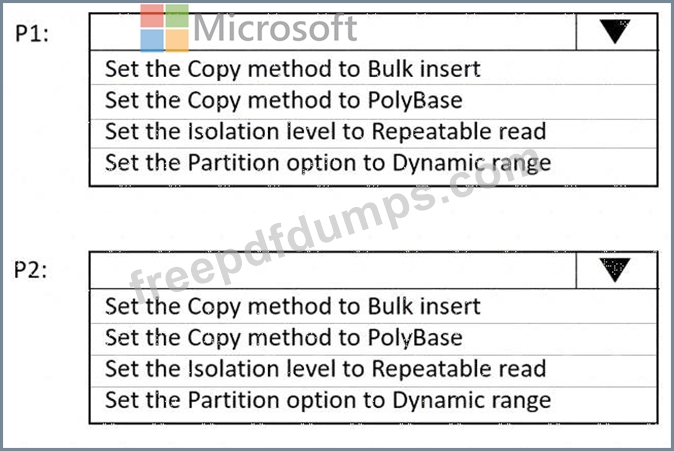
ADF1 contains the following pipelines:
* P1: Uses a copy activity to copy data from a nonpartitioned table in a dedicated SQL pool of WS1 to an Azure Data Lake Storage Gen2 account
* P2: Uses a copy activity to copy data from text-delimited files in an Azure Data Lake Storage Gen2 account to a nonpartitioned table in a dedicated SQL pool of WS2 You need to configure P1 and P2 to maximize parallelism and performance.
Which dataset settings should you configure for the copy activity if each pipeline? To answer, select the appropriate options in the answer area.
NOTE: Each correct selection is worth one point.


DP-203 Exam Question 12
You have an Azure Synapse Analytics dedicated SQL pool named SA1 that contains a table named Table1.
You need to identify tables that have a high percentage of deleted rows. What should you run?
You need to identify tables that have a high percentage of deleted rows. What should you run?
DP-203 Exam Question 13
You have two Azure Data Factory instances named ADFdev and ADFprod. ADFdev connects to an Azure DevOps Git repository.
You publish changes from the main branch of the Git repository to ADFdev.
You need to deploy the artifacts from ADFdev to ADFprod.
What should you do first?
You publish changes from the main branch of the Git repository to ADFdev.
You need to deploy the artifacts from ADFdev to ADFprod.
What should you do first?
DP-203 Exam Question 14
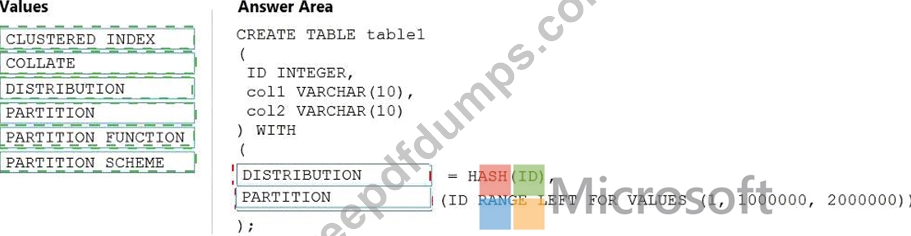
You need to create a partitioned table in an Azure Synapse Analytics dedicated SQL pool.
How should you complete the Transact-SQL statement? To answer, drag the appropriate values to the correct targets. Each value may be used once, more than once, or not at all. You may need to drag the split bar between panes or scroll to view content.
NOTE: Each correct selection is worth one point.
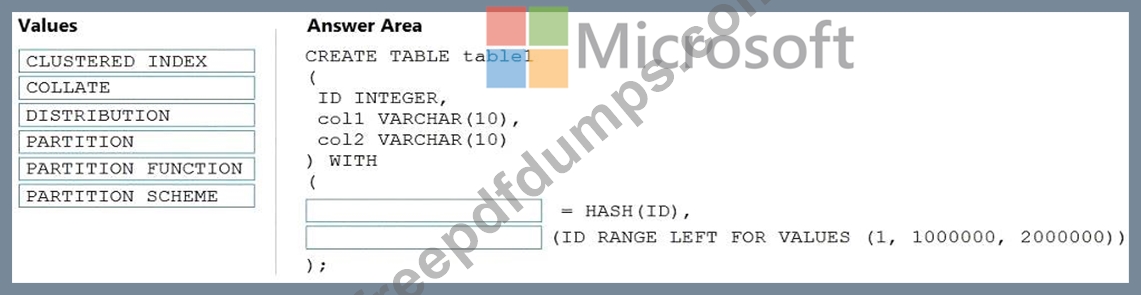
How should you complete the Transact-SQL statement? To answer, drag the appropriate values to the correct targets. Each value may be used once, more than once, or not at all. You may need to drag the split bar between panes or scroll to view content.
NOTE: Each correct selection is worth one point.

DP-203 Exam Question 15
Note: This question is part of a series of questions that present the same scenario. Each question in the series contains a unique solution that might meet the stated goals. Some question sets might have more than one correct solution, while others might not have a correct solution.
After you answer a question in this section, you will NOT be able to return to it. As a result, these questions will not appear in the review screen.
You have an Azure Synapse Analytics dedicated SQL pool that contains a table named Table1.
You have files that are ingested and loaded into an Azure Data Lake Storage Gen2 container named container1.
You plan to insert data from the files in container1 into Table1 and transform the data. Each row of data in the files will produce one row in the serving layer of Table1.
You need to ensure that when the source data files are loaded to container1, the DateTime is stored as an additional column in Table1.
Solution: You use a dedicated SQL pool to create an external table that has an additional DateTime column.
Does this meet the goal?