

SC-300 Exam Question 21
You have an Azure Active Directory (Azure AD) tenant that syncs to an Active Directory domain.
The on-premises network contains a VPN server that authenticates to the on-premises Active Directory domain. The VPN server does NOT support Azure Multi-Factor Authentication (MFA).
You need to recommend a solution to provide Azure MFA for VPN connections.
What should you include in the recommendation?
The on-premises network contains a VPN server that authenticates to the on-premises Active Directory domain. The VPN server does NOT support Azure Multi-Factor Authentication (MFA).
You need to recommend a solution to provide Azure MFA for VPN connections.
What should you include in the recommendation?
SC-300 Exam Question 22
You have a Microsoft 365 tenant.
The Azure Active Directory (Azure AD) tenant syncs to an on-premises Active Directory domain. The domain contains the servers shown in the following table.

The domain controllers are prevented from communicating to the internet.
You implement Azure AD Password Protection on Server1 and Server2.
You deploy a new server named Server4 that runs Windows Server 2019.
You need to ensure that Azure AD Password Protection will continue to work if a single server fails.
What should you implement on Server4?
The Azure Active Directory (Azure AD) tenant syncs to an on-premises Active Directory domain. The domain contains the servers shown in the following table.
The domain controllers are prevented from communicating to the internet.
You implement Azure AD Password Protection on Server1 and Server2.
You deploy a new server named Server4 that runs Windows Server 2019.
You need to ensure that Azure AD Password Protection will continue to work if a single server fails.
What should you implement on Server4?
SC-300 Exam Question 23
You have an Azure Active Directory (Azure AD) tenant that syncs to an Active Directory forest. The tenant-uses through authentication.
A corporate security policy states the following:
* Domain controllers must never communicate directly to the internet.
* Only required software must be- installed on servers.
The Active Directory domain contains the on-premises servers shown in the following table.
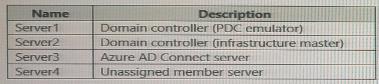
You need to ensure that users can authenticate to Azure AD if a server fails.
On which server should you install an additional pass-through authentication agent?
A corporate security policy states the following:
* Domain controllers must never communicate directly to the internet.
* Only required software must be- installed on servers.
The Active Directory domain contains the on-premises servers shown in the following table.
You need to ensure that users can authenticate to Azure AD if a server fails.
On which server should you install an additional pass-through authentication agent?
SC-300 Exam Question 24
Your network contains an on-premises Active Directory domain that sync to an Azure Active Directory (Azure AD) tenant. The tenant contains the shown in the following table.
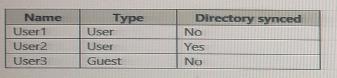
All the users work remotely.
Azure AD Connect is configured in Azure as shown in the following exhibit.
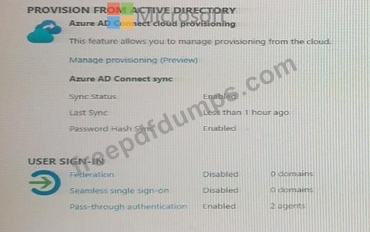
Connectivity from the on-premises domain to the internet is lost.
Which user can sign in to Azure AD?
All the users work remotely.
Azure AD Connect is configured in Azure as shown in the following exhibit.
Connectivity from the on-premises domain to the internet is lost.
Which user can sign in to Azure AD?
SC-300 Exam Question 25
You have an Azure Active Directory (Azure AD) tenant.
You create an enterprise application collection named HR Apps that has the following settings:
* Applications: Appl. App?, App3
* Owners: Admin 1
* Users and groups: HRUsers
AH three apps have the following Properties settings:
* Enabled for users to sign in: Yes
* User assignment required: Yes
* Visible to users: Yes
Users report that when they go to the My Apps portal, they only sue App1 and App2-You need to ensure that the users can also see App3. What should you do from App3?
What should you do from App3?
You create an enterprise application collection named HR Apps that has the following settings:
* Applications: Appl. App?, App3
* Owners: Admin 1
* Users and groups: HRUsers
AH three apps have the following Properties settings:
* Enabled for users to sign in: Yes
* User assignment required: Yes
* Visible to users: Yes
Users report that when they go to the My Apps portal, they only sue App1 and App2-You need to ensure that the users can also see App3. What should you do from App3?
What should you do from App3?