

CAPM Exam Question 321
Which type of analysis is used as a general management technique within the Plan Procurements process?
Correct Answer: B
In accordance with the PMBOKGuide, specifically within the Plan Procurement Management process, Make-or-buy analysis is the primary general management technique used to determine whether particular work can best be accomplished by the project team or should be purchased from outside sources.
Core Objective: This analysis is used to reach a decision on whether the organization should produce the product or service itself (Make) or purchase it from an external vendor (Buy).
* Factors Considered:
* Cost: Comparing the direct and indirect costs of internal production versus the purchase price and ongoing support costs of a vendor.
* Capacity and Capability: Evaluating if the internal team has the skills, tools, and time available to perform the work.
* Strategic Alignment: Determining if the work is a core competency that should remain in-house or if it is a commodity better handled by specialists.
* Risk: Assessing the risks associated with internal execution versus the risks of relying on a third- party provider.
* The Output: The primary result of this analysis is the Make-or-Buy Decisions, which are documented and used to move forward with the procurement process if a " buy " decision is reached.
Comparison with Other Options:
Risk assessment analysis (A): While risk is a factor in procurement, " Risk Assessment " is a broader set of processes (Identify Risks, etc.) and not the specific management technique defined for making the initial procurement choice.
* Contract value analysis (C): This is a distractor term. While the value is analyzed, it falls under cost analysis or price evaluation during the " Conduct Procurements " phase.
* Cost impact analysis (D): This is a general term often used in change management to see how a change affects the budget, but it is not the specific technique used in the Plan Procurements process to decide between internal and external work.
CAPM Exam Question 322
A project manager is calculating the current budget. The earned value (EV) of the project is lower than the actual cost (AC) of the project.
How should the project manager report the status of the project?
How should the project manager report the status of the project?
Correct Answer: A
In the Control Costs process of the PMBOKGuide, Earned Value Management (EVM) is used to provide a snapshot of the project ' s financial and schedule health.
Why Choice A is correct:
The Calculation: Cost Variance (CV) is calculated as $CV = EV - AC$.
The Result: If the Earned Value (EV) is lower than the Actual Cost (AC) (e.g., $EV = 80$ and $AC = 100$), the result is a negative number ($80 - 100 = -20$).
Interpretation: A negative CV indicates that the work performed cost more than the value of the work actually achieved. In simpler terms, the project is over budget.
Risk: Being over budget is a significant risk to project success, as it may lead to resource shortages or the need for additional funding from the management reserve.
Analysis of other options:
B (Within budget and schedule): This is incorrect because $EV < AC$ explicitly means the project is over budget. We do not have enough information to determine the schedule status (which would require Planned Value), but the cost status is definitely not " within budget. " C (Within budget but delayed): This is incorrect because, again, $EV < AC$ means the project is not within budget. Whether it is delayed depends on the Schedule Variance ($SV = EV - PV$), for which data is not provided.
D (Tracking well as CV is negative): This is a contradiction. A negative Cost Variance is never a sign of " tracking well " ; it is an indicator of poor financial performance.
Key Concept:
The Project Management Institute (PMI) teaches that Cost Variance (CV) is a critical indicator of project health. A negative value (Choice A) acts as an early warning system, prompting the project manager to investigate causes-such as inefficiencies, scope creep, or underestimated costs-and implement corrective actions to bring the project back in line with the Cost Baseline.
CAPM Exam Question 323
What is the process of determining the stakeholders impacted by a business problem or opportunity?
Correct Answer: C
In the PMBOKGuide and the PMI Guide to Business Analysis, understanding the human landscape of a project is critical. While identifying who the stakeholders are is the first step, determining how they are impacted requires a deeper dive.
Why Choice C is correct:
Defining the Impact: Stakeholder Analysis is the technique used to systematically gather and analyze quantitative and qualitative information to determine whose interests should be taken into account throughout the project.
Evaluating Influence and Interest: It involves identifying the stakeholders ' goals, expectations, and levels of influence. Crucially, it assesses how the business problem or the proposed solution will affect their daily work, power dynamics, or specific business units.
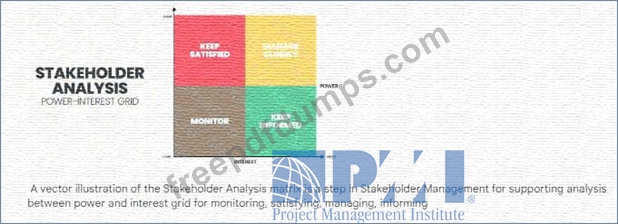
Output: This analysis typically results in a Stakeholder Register or models such as the Power/Interest Grid, which categorize stakeholders so the project manager can develop appropriate engagement strategies.
Analysis of other options:
A (Stakeholder requirements): These are the specific needs or conditions that a stakeholder requires to be met by a product or service. Requirements are the result of discussions with stakeholders; they are not the process of determining who is impacted by a problem.
B (Stakeholder identification): This is the initial process of simply listing the people, groups, or organizations that could be involved. While it precedes analysis, " Identification " is about finding the names, whereas " Analysis " (Choice C) is the specific process of determining the impact and relationship to the business problem.
D (Stakeholder characteristics): This refers to the traits or attributes of a stakeholder (such as their location, attitude, or knowledge level). Like requirements, these are data points gathered during the analysis, not the name of the process itself.
Key Concept: The Project Management Institute (PMI) teaches that Stakeholder Analysis (Choice C) is an ongoing activity. As a business problem evolves or a new opportunity is defined, the project manager must re- analyze the stakeholder landscape to ensure that those who are most impacted are properly engaged and that their potential resistance or support is managed effectively.
Why Choice C is correct:
Defining the Impact: Stakeholder Analysis is the technique used to systematically gather and analyze quantitative and qualitative information to determine whose interests should be taken into account throughout the project.
Evaluating Influence and Interest: It involves identifying the stakeholders ' goals, expectations, and levels of influence. Crucially, it assesses how the business problem or the proposed solution will affect their daily work, power dynamics, or specific business units.
Output: This analysis typically results in a Stakeholder Register or models such as the Power/Interest Grid, which categorize stakeholders so the project manager can develop appropriate engagement strategies.
Analysis of other options:
A (Stakeholder requirements): These are the specific needs or conditions that a stakeholder requires to be met by a product or service. Requirements are the result of discussions with stakeholders; they are not the process of determining who is impacted by a problem.
B (Stakeholder identification): This is the initial process of simply listing the people, groups, or organizations that could be involved. While it precedes analysis, " Identification " is about finding the names, whereas " Analysis " (Choice C) is the specific process of determining the impact and relationship to the business problem.
D (Stakeholder characteristics): This refers to the traits or attributes of a stakeholder (such as their location, attitude, or knowledge level). Like requirements, these are data points gathered during the analysis, not the name of the process itself.
Key Concept: The Project Management Institute (PMI) teaches that Stakeholder Analysis (Choice C) is an ongoing activity. As a business problem evolves or a new opportunity is defined, the project manager must re- analyze the stakeholder landscape to ensure that those who are most impacted are properly engaged and that their potential resistance or support is managed effectively.
CAPM Exam Question 324
Stakeholders can be identified in later stages of the project because the Identify Stakeholders process should be:
Correct Answer: A
According to the PMBOKGuide (Project Management Body of Knowledge), specifically within the Project Stakeholder Management knowledge area, the nature of stakeholder identification is a dynamic and evolving activity throughout the project life cycle.
Continuous (Option A): The Identify Stakeholders process is defined by PMI as a process that is performed periodically throughout the project as needed. Stakeholders may change, or new stakeholders may be identified, as the project moves through its different phases (e.g., transitioning from design to construction or from development to testing). Therefore, the process must be continuous and iterative to ensure that all individuals, groups, or organizations that could impact or be impacted by the project are captured in the Stakeholder Register.
* Discrete (Option B): A discrete process would imply that stakeholder identification happens once (likely at the beginning) and is then finished. This is incorrect in the PMI framework, as missing a stakeholder who emerges mid-project can lead to significant risks or scope creep.
* Regulated (Option C): While the process follows specific standards and organizational process assets (OPAs), " regulated " does not describe the timing or frequency of the activity in the way that " continuous " does.
* Arbitrary (Option D): This implies that the process is based on random choice or personal whim rather than a systematic approach. PMI processes are structured and deliberate, never arbitrary.
In the PMI framework, the Stakeholder Register is a living document. By treating identification as a continuous process, the Project Manager can adjust engagement strategies to account for the shifting landscape of project influence and interest.
CAPM Exam Question 325
Which type of elaboration allows a project management team to manage at a greater level of detail as the project evolves?
Correct Answer: B
According to the PMBOKGuide, the concept of Progressive Elaboration is a fundamental characteristic of projects. it is the process of continuously improving and detailing a plan as more detailed information and more accurate estimates become available.
Progressive elaboration allows a project management team to define work and manage it at a greater level of detail as the project evolves.
* The Logic of Uncertainty: At the beginning of a project, many details are unknown. As the project moves through its lifecycle, the team gains a better understanding of the objectives and deliverables.
* Rolling Wave Planning: This is a specific form of progressive elaboration where the work to be accomplished in the near term is planned in detail, while the work in the future is planned at a higher level (the WBS is expanded as the project progresses).
* Integration with Scope: It is particularly visible in the development of the Project Scope Statement and the Work Breakdown Structure (WBS), where high-level requirements are eventually broken down into specific work packages.
* A. Cyclic: While some project life cycles (like Agile) involve cycles, " Cyclic Elaboration " is not a standard PMI term for the refinement of project details over time.
* C. Repetitive: This term implies doing the same thing over again, which describes " Operations " rather than the unique, evolving nature of a " Project. "
* D. Iterative: While an Iterative Life Cycle is one where the project scope is generally determined early but time and cost estimates are routinely modified as the team ' s understanding of the product increases, " Progressive Elaboration " is the specific technique or process used across all project types to increase detail.
For the exam, it is important to distinguish Progressive Elaboration (which is planned and necessary) from Scope Creep (which is the uncontrolled expansion of product or project scope without adjustments to time, cost, and resources). Progressive elaboration refines the existing objectives; it does not add new ones.
- Other Version
- 2883PMI.CAPM.v2026-09-05.q632
- 4955PMI.CAPM.v2026-07-17.q643
- 5552PMI.CAPM.v2023-02-14.q281
- 12165PMI.CAPM.v2022-05-24.q570
- 59PMI.Pass4guide.CAPM.v2022-05-12.by.shirley.570q.pdf
- 15037PMI.CAPM.v2022-01-02.q768
- 89PMI.Exams4sures.CAPM.v2021-08-25.by.odelette.722q.pdf
- Latest Upload
- 161Oracle.1Z0-931-26.v2026-10-19.q61
- 158Microsoft.AI-200.v2026-10-19.q43
- 134Oracle.1z0-1195-26.v2026-10-19.q23
- 243Microsoft.MS-102.v2026-10-19.q259
- 229ECCouncil.312-50v13.v2026-10-19.q453
- 201Oracle.1Z0-1110-26.v2026-10-17.q71
- 265CloudSecurityAlliance.CCSK.v2026-10-17.q153
- 299Salesforce.Platform-App-Builder.v2026-10-17.q161
- 181Salesforce.AP-204.v2026-10-17.q40
- 278Microsoft.AI-103.v2026-10-16.q46