

CAPM Exam Question 331
Which subsidiary management plan.... during the project ilfe cycle?
Which Subsidiary management plan would a project manager create to manage Information dissemination during the project life cycle?
Which Subsidiary management plan would a project manager create to manage Information dissemination during the project life cycle?
Correct Answer: C
According to the PMBOKGuide, specifically the Plan Communications Management process, the project manager must develop an appropriate approach and plan for project communication activities based on stakeholders' information needs and requirements.
* Communications Management Plan (Choice C): This is the specific subsidiary management plan that describes how, when, and by whom information about the project will be administered and disseminated. It covers the " who, what, when, where, why, and how " of information flow. Key elements of this plan include information distribution frequencies, methods (email, meetings, portals), and the person responsible for communicating specific information.
* Stakeholder Engagement Plan (Choice A): While closely related, this plan focuses on the strategies to involve stakeholders and manage their expectations. It identifies the " why " and " how " of engagement, whereas the Communications Management Plan focuses on the actual dissemination of the project information itself.
* Quality Management Plan (Choice B): This plan describes how the project management team will implement the organization ' s quality policy. It focuses on standards, metrics, and quality control
/assurance, not information dissemination.
* Scope Management Plan (Choice D): This plan describes how the scope will be defined, developed, monitored, controlled, and validated. It does not deal with the communication of project status or general info dissemination.
The Communications Management Plan is vital for ensuring that the right message reaches the right audience at the right time through the most effective channel, thereby minimizing misunderstandings and ensuring transparency throughout the project life cycle.
CAPM Exam Question 332
What is a key benefit of using virtual project teams?
Correct Answer: D
According to the PMBOKGuide, specifically within the Develop Team and Acquire Resources processes, virtual teams are groups of people with a shared goal who fulfill their roles with little or no time spent meeting face-to-face.
Cost Reduction: One of the primary drivers for implementing virtual teams is the reduction of project costs.
Organizations can save significantly on travel expenses, relocation costs, and the physical infrastructure (office space, utilities, etc.) required to house a co-located team.
* Access to Expertise: Beyond cost, virtual teams allow a project manager to acquire specialized skills that may not be available in a single geographic area. By using modern communication technologies, the team can collaborate regardless of their physical location.
* Global Talent Pool: Virtual teams enable the inclusion of people with mobility limitations or those who work different shifts, creating a " follow-the-sun " model that can actually increase productivity across time zones.
Why other options are incorrect:
Option A: Ensures appropriate behavior, security, and protection of information: Virtual teams actually face greater challenges in these areas. Monitoring behavior and ensuring data security is often more complex when team members are working from dispersed, remote locations.
* Option B: Reduces the risk of conflict: Virtual teams often experience more conflict, not less. The lack of non-verbal cues (body language, tone of voice) in digital communication can lead to misunderstandings, feelings of isolation, and " us vs. them " mentalities between different sites.
* Option C: Assures that all team members have a clear and common understanding: Achieving a " shared mental model " is significantly harder in a virtual environment. Co-located teams benefit from " osmotic communication, " whereas virtual teams must be much more intentional and disciplined to ensure everyone is on the same page.
CAPM Exam Question 333
The degree, amount, or volume of risk that an organization or individual will withstand is known as its risk:
Correct Answer: C
According to the PMBOKGuide (Project Management Body of Knowledge) and the PMI Lexicon of Project Management Terms, it is crucial to distinguish between " Appetite " and " Tolerance, " as they are often confused in practice:
Risk Tolerance: This is specifically defined as the specified range of acceptable results or the degree, amount, or volume of risk that an organization or individual is willing to withstand. It represents a measurable threshold. For example, a project might have a budget tolerance of plus or minus 10%. If the risk threatens to exceed that 10%, it is beyond the organization ' s tolerance.
* Risk Appetite (Option B): This is the degree of uncertainty an organization or individual is willing to accept in anticipation of a reward. It is a more general, high-level guiding principle or " hunger " for risk rather than a specific measurable volume of withstandable risk.
* Risk Analysis (Option A): This is the process of examining identified risks to estimate the probability and impact. It is a step in the Risk Management process, not a measurement of the capacity to withstand risk.
* Risk Response (Option D): This refers to the specific actions or strategies (such as Avoid, Transfer, Mitigate, or Accept) taken to address risks once they have been analyzed.
In the context of the Standard for Risk Management in Portfolios, Programs, and Projects, " Tolerance " acts as the measurable boundary for " Appetite. " Because the question specifically asks for the " degree, amount, or volume " that can be withstood, Tolerance is the most precise and verified term.
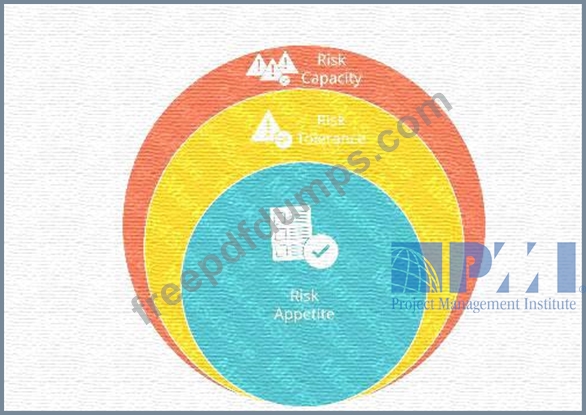
Risk Tolerance: This is specifically defined as the specified range of acceptable results or the degree, amount, or volume of risk that an organization or individual is willing to withstand. It represents a measurable threshold. For example, a project might have a budget tolerance of plus or minus 10%. If the risk threatens to exceed that 10%, it is beyond the organization ' s tolerance.
* Risk Appetite (Option B): This is the degree of uncertainty an organization or individual is willing to accept in anticipation of a reward. It is a more general, high-level guiding principle or " hunger " for risk rather than a specific measurable volume of withstandable risk.
* Risk Analysis (Option A): This is the process of examining identified risks to estimate the probability and impact. It is a step in the Risk Management process, not a measurement of the capacity to withstand risk.
* Risk Response (Option D): This refers to the specific actions or strategies (such as Avoid, Transfer, Mitigate, or Accept) taken to address risks once they have been analyzed.
In the context of the Standard for Risk Management in Portfolios, Programs, and Projects, " Tolerance " acts as the measurable boundary for " Appetite. " Because the question specifically asks for the " degree, amount, or volume " that can be withstood, Tolerance is the most precise and verified term.
CAPM Exam Question 334
Project contracts generally fall into which of the following three broad categories?
Correct Answer: A
According to the PMBOKGuide, specifically within the Plan Procurement Management process, project contracts are generally categorized into three broad types based on how the risk is shared between the buyer and the seller.
Fixed-Price Contracts (FP): This category involves setting a fixed total price for a defined product, service, or result to be provided. It places the greatest risk on the seller, as they are responsible for any cost overruns.
Sub-types include Firm Fixed Price (FFP) and Fixed Price Incentive Fee (FPIF).
* Cost-Reimbursable Contracts (CR): This category involves payments to the seller for all legitimate actual costs incurred for completed work, plus a fee representing seller profit. This category places the greatest risk on the buyer. Sub-types include Cost Plus Fixed Fee (CPFF) and Cost Plus Incentive Fee (CPIF).
* Time and Materials Contracts (TandM): This is a hybrid type of contractual arrangement that contains aspects of both cost-reimbursable and fixed-price contracts. They are often used for staff augmentation or when a precise statement of work cannot be quickly prescribed. They are typically used for smaller dollar amounts or short-term engagements.
Analysis of Other Options:
B and C. Margin analysis: This is a financial calculation used to determine profitability, not a category of procurement contract.
* D. Make-or-buy: This is a tool and technique used to determine whether particular work can best be accomplished by the project team or should be purchased from outside sources; it is not a contract category itself.
CAPM Exam Question 335
For a stakeholder with low interest and high power, the project manager should:
Correct Answer: C
According to the PMBOKGuide (Project Management Body of Knowledge), specifically within the Project Stakeholder Management knowledge area and the Power/Interest Grid tool and technique used in the Identify Stakeholders process:
* Keep Satisfied (Option C): Stakeholders with high power but low interest are influential individuals who are not currently concerned with the day-to-day details of the project. However, because of their high power, they can significantly impact the project ' s success if they become dissatisfied. The Project Manager ' s strategy is to keep them satisfied by meeting their needs and ensuring they do not become a source of resistance, without overwhelming them with excessive information.
* Monitor (Option A): This strategy is reserved for stakeholders with low power and low interest. The Project Manager monitors them for any changes in their status but puts forth minimal effort.
* Manage Closely (Option B): This is the strategy for " Key Stakeholders " who have both high power and high interest. These individuals require the highest level of engagement and frequent communication.
* Keep Informed (Option D): This strategy applies to stakeholders with low power but high interest.
These stakeholders are often helpful with project details and should be kept informed to maintain their support, but they lack the authority to dictate project direction.
In the PMI framework, the Power/Interest Grid is a fundamental tool for performing Stakeholder Analysis. By categorizing stakeholders into these four quadrants, the Project Manager can tailor the Stakeholder Engagement Plan to allocate resources efficiently, ensuring that the most influential figures are appropriately managed to support the project ' s strategic objectives.
- Other Version
- 2883PMI.CAPM.v2026-09-05.q632
- 4955PMI.CAPM.v2026-07-17.q643
- 5552PMI.CAPM.v2023-02-14.q281
- 12165PMI.CAPM.v2022-05-24.q570
- 59PMI.Pass4guide.CAPM.v2022-05-12.by.shirley.570q.pdf
- 15037PMI.CAPM.v2022-01-02.q768
- 89PMI.Exams4sures.CAPM.v2021-08-25.by.odelette.722q.pdf
- Latest Upload
- 161Oracle.1Z0-931-26.v2026-10-19.q61
- 158Microsoft.AI-200.v2026-10-19.q43
- 134Oracle.1z0-1195-26.v2026-10-19.q23
- 243Microsoft.MS-102.v2026-10-19.q259
- 229ECCouncil.312-50v13.v2026-10-19.q453
- 201Oracle.1Z0-1110-26.v2026-10-17.q71
- 265CloudSecurityAlliance.CCSK.v2026-10-17.q153
- 299Salesforce.Platform-App-Builder.v2026-10-17.q161
- 181Salesforce.AP-204.v2026-10-17.q40
- 278Microsoft.AI-103.v2026-10-16.q46