Which of the following is the most likely reason an organization might implement compensating controls?
Correct Answer: A
Compensating controls are appropriate when the preferred remediation cannot currently be implemented but the organization must still reduce exposure. A mission-critical system with an unpatched vulnerability for which no vendor patch exists is a classic example. The system cannot simply be removed from service because the business requires it, and conventional patching is unavailable. The organization may therefore deploy alternative controls such as network segmentation, restrictive firewall rules, application allowlisting, disabling unnecessary services, enhanced monitoring, IPS signatures, access restrictions, or isolation of affected functionality. These measures do not eliminate the underlying defect; instead, they reduce the probability or impact of exploitation while a permanent solution is developed. NIST's control framework is designed to allow security controls to be selected and tailored according to organizational mission requirements and risk, supporting the broader principle that organizations may apply appropriate alternative safeguards when operational constraints exist. Option B requires no compensating control because remediation has already occurred. Option C describes a vulnerability that is not applicable to the organization's systems. Option D represents a false positive and therefore does not constitute an actual exposure requiring mitigation. Study Guide Reference: Vulnerability Management # Mitigation # Compensating Controls # Patch Availability # Mission-Critical Systems # Segmentation and Monitoring.
CS0-004 Exam Question 12
Which of the following is the best reason to heavily segment business-critical assets from within the network?
Correct Answer: A
Legacy systems present a significant security problem because they frequently cannot support current operating systems, security agents, encryption mechanisms, authentication controls, or vendor patches. When a business-critical legacy system cannot be remediated normally, strong network segmentation becomes an important compensating control. The objective is to reduce the system's reachable attack surface and restrict which users, hosts, protocols, and applications can communicate with it. A segmented legacy asset might be placed in a dedicated VLAN or security zone and protected through restrictive firewall access-control rules, jump hosts, allowlisting, enhanced logging, and continuous monitoring. Even though segmentation does not remove the underlying vulnerability, it decreases exposure and makes exploitation or lateral movement considerably more difficult. Degraded functionality is generally an effect or remediation constraint rather than the strongest reason for isolation. Asset obfuscation does not provide reliable security because hidden systems can still be discovered through enumeration or traffic analysis. A proprietary server is not automatically vulnerable merely because its implementation is proprietary; it may still support modern patches and security controls. CS0-004 specifically covers segmentation as a vulnerability-scanning consideration, compensating controls as a mitigation strategy, and legacy systems as an important inhibitor to remediation. Study Guide Reference: Vulnerability Management # Vulnerability Prioritization and Mitigation # Compensating Controls # Segmentation # Legacy-System Constraints.
CS0-004 Exam Question 13
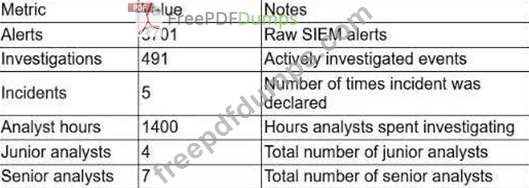
The Chief Information Security Officer (CISO) reviews the following security operations metrics from the last month: Which of the following is the best action to improve overall security operations efficiency?
Correct Answer: B
The most direct method for improving SOC efficiency when excessive alerts are non-actionable is to identify the detections generating that noise and perform rule and alert tuning . Non-actionable detections consume analyst time, increase queue depth, contribute to alert fatigue, and can obscure genuinely malicious activity. Tuning may include adjusting thresholds, refining correlation logic, adding exclusions for legitimate behavior, improving indicator context, modifying detection conditions, or disabling rules that consistently generate false positives without meaningful security value. A cloud security posture management platform may improve context for cloud-related findings, but it does not directly correct poorly performing detection logic across the broader SOC. Playbooks improve consistency and reduce investigation variability, particularly for junior analysts, but they still force personnel to process alerts that should not have been generated. Training can improve analyst performance, yet it also fails to address the source of excessive non-actionable notifications. The CS0-004 Security Operations objectives explicitly identify efficiency and process improvement , including standardized processes, automation and orchestration, data enrichment, rule/alert tuning , dashboard creation, and technology integration. Therefore, the optimal operational improvement is to reduce unnecessary workload at the detection layer itself. Study Guide Reference: Security Operations # Efficiency and Process Improvement # Data Enrichment # Rule/Alert Tuning # SOC Optimization.
CS0-004 Exam Question 14
A security analyst runs an Nmap scan against a host with multiple open ports using the following command: nmap 10.10.10.1 -p- The following output is obtained after the scan: Starting Nmap 7.95 ( https://nmap.org ) at 2025-07-15 15:55 UTC Note: Host seems down. Nmap done: 1 IP address (0 hosts up) scanned in 3.16 seconds Which of the following is the most accurate way to scan the target IP for open ports?
Correct Answer: C
The original scan fails because Nmap's host-discovery process concludes that the target appears offline before conducting the intended full port scan. Option C adds -Pn , instructing Nmap to skip normal host discovery and proceed with scanning the target as though it is online. The -p- option then instructs Nmap to test the complete TCP port range rather than only its default set. This is appropriate when a live host does not respond to discovery probes because ICMP echo traffic or other discovery packets may be filtered by firewalls, host-based controls, or network policy. A system can therefore appear "down" to Nmap's discovery phase while still exposing reachable TCP services. Option B uses -sn, which performs host discovery without a port scan and therefore contradicts the requirement. Option A scans only a limited set of explicitly identified ports and includes unrelated functionality. Option D unnecessarily changes the scope to an entire /24, performs operating-system detection and DNS resolution, and invokes an SSL cipher script; none of those modifications addresses the immediate host-discovery problem. Study Guide Reference: Vulnerability Management # Nmap # Host Discovery # -Pn # Full Port Scanning - p- # Firewall/ICMP Filtering # Scan Troubleshooting.
CS0-004 Exam Question 15
A Chief Information Security Officer (CISO) evaluates a threat heat map and notices a substantial increase in custom scanning and enumeration activities. The CISO wants to gather as much information as possible about the activities targeting the company to help prioritize mitigations. Which of the following solutions is the best way to accomplish this goal?
Correct Answer: A
A honeypot is the strongest choice because the objective is not merely to block activity but to collect detailed intelligence about how adversaries are scanning, enumerating, and interacting with the organization. A properly isolated honeypot deliberately presents an attractive target while allowing defenders to observe attacker behavior without exposing legitimate production assets. The resulting telemetry can reveal source infrastructure, targeted services, enumeration sequences, exploit attempts, command patterns, tools, payloads, and potentially broader TTPs. MITRE D3FEND defines a decoy environment as hosts and networks established specifically to deceive an attacker, and describes honeypots as decoy network resources that can expose an attacker's potential intent and strategy. Canary tokens are valuable high-confidence tripwires but generally provide narrower detection evidence. Threat-intelligence subscriptions provide external intelligence and may help with prioritization, yet they will not provide the same organization-specific visibility into actors actively interacting with the company's exposed environment. A WAF can log web attacks and block malicious requests, but its visibility is primarily limited to web application traffic. Study Guide Reference: Security Operations # Threat Intelligence # Threat Hunting # Deception Technologies # Honeypots/Honeynets # Adversary TTP Collection.