

HPE7-A06 Exam Question 6
Place the recommended troubleshooting steps in order.

Correct Answer:

Explanation:
The correct order is:
* identify
* analyze
* hypothesize
* validate
* implement
* verify
This question requires arranging standard troubleshooting steps into a logical sequence. A systematic approach is crucial for effective network troubleshooting.
* identify:The first step is always to clearly identify and define the problem. What are the symptoms?
Who is affected? What is the scope? When did it start? Understanding the problem precisely is essential before proceeding.
* analyze:Once the problem is identified, gather relevant data and analyze the situation. This involves checking logs, looking at configurations, examining network topology diagrams, checking status commands, and potentially capturing packets. This analysis helps build context around the identified issue.
* hypothesize:Based on the identification and analysis, form a hypothesis (or multiple hypotheses) about the probable cause of the problem. This involves using technical knowledge and experience to theorize what might be wrong.
* validate:Test the hypothesis to determine if it's correct. This step involves performing specific tests or checks designed to confirm or refute the theory. For example, if the hypothesis is a bad cable, test the cable. If it's a routing issue, check the routing table and perform trace routes. This step validates the cause before implementing a fix.
* implement:Once the cause has been validated, implement the solution. This could involve replacing hardware, correcting configuration, clearing states, etc.
* verify:After implementing the solution, verify that the original problem is resolved. It's also critical to check that the fix hasn't introduced any new issues. Monitor the system to ensure stability.
References:Standard Network Troubleshooting Methodologies (e.g., CompTIA Network+, Cisco troubleshooting models), ITIL Problem Management processes. This directly relates to the "Troubleshooting" (10%) objective, which emphasizes performing advanced troubleshooting and remediation.
HPE7-A06 Exam Question 7
Which is a best practice for configuringGBP?
Correct Answer: D
The question asks for a best practice when configuring Group-Based Policy (GBP). GBP simplifies policy management by assigning users/devices to roles and defining policies between these roles, often leveraging dynamic assignment from an authentication server.
* GBP Concepts:Policies are typically defined based on source and destination roles. Roles can be assigned statically on the switch or dynamically via an authentication server like ClearPass.
* Analysis of Options:
* A & C: Policies define interactionsbetweenroles (source role to destination role). These roles can be the same (intra-role policy) or different (inter-role policy). Neither option represents a singular
"best practice" for all configurations.
* B: Using Static User Roles (SUR) is possible but less flexible and scalable than dynamic assignment for large or complex environments.
* D: Using Downloadable User Roles (DUR) is generally considered a best practice. DUR allows roles and associated policies (including GBP attributes like GPID) to be centrally defined on an authentication server (e.g., ClearPass) and dynamically assigned to users/devices uponsuccessful authentication. This provides scalability, consistency, and easier management.
* Conclusion:Leveraging Downloadable User Roles (DUR) from a central authentication server like ClearPass is a best practice for implementing scalable and manageable Group-Based Policies.
References:Aruba Dynamic Segmentation concepts, Group-Based Policy (GBP) documentation, Aruba ClearPass integration guides. This relates to "Security" (10%) and "Authentication/Authorization" (9%) objectives.
HPE7-A06 Exam Question 8
Which issue may becausing the new door locks on the APs to notwork?
Correct Answer: C
New PoE-powered door locks, connected via the PoE passthrough port on Aruba APs, are not working. We need to find the likely cause related to PoE power.
* PoE Passthrough:An AP feature where the AP, powered by PoE from a switch, provides PoE power out to another device connected to one of its Ethernet ports.
* Power Budget:The AP must receive enough power from the switch via its PoE input (e.g., 802.3af,
802.3at, 802.3bt) to power itselfandmeet the power demand of the downstream device (the door lock).
* PoE Standards Power (Approx. Available to Device):
* 802.3af (PoE): ~13 Watts
* 802.3at (PoE+): ~25.5 Watts
* 802.3bt (PoE++): 51W (Type 3) or 71W (Type 4)
* Analysis:Modern APs (especially Wi-Fi 6/6E) can consume significant power themselves (>15W or
>25W under load). Standard 802.3af PoE (supplying only ~13W) is often insufficient to power both a modern AP and a downstream PoE device like a door lock. The AP will power up, but won't enable PoE output if its input power budget is insufficient.
* Analysis of Options:
* A, B: Too much power (AT/BT) isn't the issue; devices only draw what they need.
* C: AF power (~13W) received by the AP is very likelynot enoughto power both the AP and the door lock.
* D: AT power (~25.5W)mightbe insufficient if the combined load of the AP and lock exceeds this, but AF being insufficient (C) is a more common limitation.
* Conclusion:Insufficient input power to the AP is the most common reason for PoE passthrough failure.
802.3af (PoE) power is often inadequate.
References:IEEE 802.3 PoE standards (af/at/bt), Aruba Access Point datasheets (PoE requirements, passthrough capabilities/budgets). This relates to "WLAN" (9%) and "Connectivity" (9%) objectives.
HPE7-A06 Exam Question 9
The clientwouldlike to automate the process of troubleshooting issues to have better visibility. Which solution would you recommend for your client?
Correct Answer: D
The client wants to automate troubleshooting processes and gain better visibility into their network. We need to identify the recommended Aruba solution.
* Analysis of Options:
* A. HPE Aruba Networking Fabric Composer: A tool primarily for data center fabric provisioning and management, not general campus troubleshooting automation.
* B. HPE Aruba Networking Switch Multi-Edit Software: Likely refers to configuration management features (e.g., in Central or NetEdit) for applying changes to multiple switches, not primarily focused on automated troubleshooting or visibility.
* C. Automate processes with scripting like Python: AOS-CX supports on-box scripting (NAE) and REST APIs, enabling custom automation for monitoring and troubleshooting. While powerful, it requires development effort.
* D. AIOps integrated into HPE Aruba Networking Central: Aruba Central's AIOps capabilities are specifically designed to enhance visibility and automate aspects of troubleshooting. It uses AI
/ML to analyze network data, detect anomalies, provide insights into potential issues, correlate events, and offer prescriptive recommendations, directly addressing the client's need for better visibility and automated assistance with troubleshooting.
* Conclusion:While custom scripting (C) allows automation, Aruba Central AIOps (D) is the platform- integrated solution specifically marketed and designed by HPE Aruba Networking to provide enhanced visibility and automated insights fortroubleshooting campus networks. It is the most direct and recommended solution among the options for achieving these goals within the Aruba ecosystem.
References:Aruba Central documentation (AIOps features), AOS-CX NAE and REST API documentation.
This relates to "Troubleshooting" (10%) and "Performance Optimization" (6%) objectives.
HPE7-A06 Exam Question 10
Exhibit.
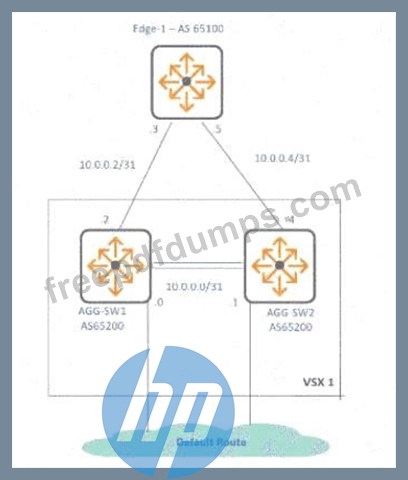
Correct Answer: C
The question involves configuring an OSPF virtual link to extend area 0 across a non-backbone area, based on an exhibit (not provided) and four configuration options (A to D). Since the exhibit is unavailable, I will assume a typical scenario where a virtual link is needed to connect two area 0 segments through a transit area (e.g., area 1).
* Analysis of Options (Assumed Context):A virtual link is configured using the area <transit-area> virtual-link <router-id> command in the OSPF process. The correct option likely includes:
* Option A:Incorrect syntax or incorrect router ID/area for the virtual link.
* Option B:Incorrect configuration, possibly missing the virtual link or using wrong parameters.
* Option C:Correct. Likely includes the proper command, e.g., area 1 virtual-link 2.2.2.2, where area 1 is the transit area and 2.2.2.2 is the router ID of the remote ABR.
* Option D:Incorrect, possibly configuring an unnecessary or incorrect virtual link.
* Why Option C is Correct:OSPF requires all areas to connect to the backbone area (area 0). If two area
0 segments are separated by a non-backbone area (e.g., area 1), a virtual link is configured between the Area Border Routers (ABRs) to logically extend area 0 through the transit area. The command area
<transit-area> virtual-link <remote-router-id> is used, specifying the transit area and the router ID of the remote ABR. Option C is assumed to provide the correct syntax and parameters based on standard OSPF virtual link configurations, ensuring area 0 connectivity and proper route advertisement.
* Relevance to Certification Objectives:
* Routing (16%):Designing and troubleshooting OSPF topologies, including virtual links.
* Troubleshooting (10%):Resolving OSPF area connectivity issues.
References:
HPE Aruba Networking AOS-CX Configuration Guide: OSPF Configuration, detailing virtual link setup.
HPE7-A06Study Guide: Covers OSPF advanced configurations like virtual links.
RFC 2328: OSPF Version 2, explaining virtual link functionality.
- Latest Upload
- 153PECB.ISO-IEC-27002-Foundation.v2026-10-21.q32
- 294Cisco.300-415.v2026-10-21.q228
- 183Fortinet.NSE5_FSW_AD-7.6.v2026-10-20.q51
- 233EC-COUNCIL.212-89.v2026-10-20.q204
- 351EC-COUNCIL.312-50.v2026-10-20.q421
- 170Oracle.1Z0-931-26.v2026-10-19.q61
- 165Microsoft.AI-200.v2026-10-19.q43
- 164Oracle.1z0-1195-26.v2026-10-19.q23
- 319Microsoft.MS-102.v2026-10-19.q259
- 426ECCouncil.312-50v13.v2026-10-19.q453
[×]
Download PDF File
Enter your email address to download HP.HPE7-A06.v2026-01-06.q32 Practice Test