

300-215 Exam Question 36
A company's security engineer notices through the SIEM that an employee's workstation sent several DNS requests involving the external IP address of the suspicious domain a4sn77d8z3dsci9416cov.com. After investigating multiple log sources, the security team determines that the employee downloaded an infected PDF file through a URL in an email. Which two elements must be included in the root cause analysis report?
(Choose two.)
(Choose two.)
300-215 Exam Question 37
Refer to the exhibit.
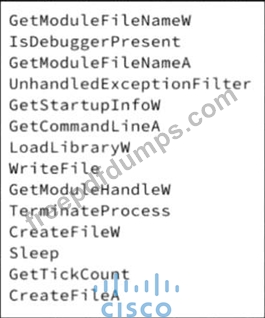
During static analysis of the potentially malicious executable obpdisp.exe, a SOC analyst identifies several functions used by the executable. Which step should the analyst take next to investigate and understand the threat further?
During static analysis of the potentially malicious executable obpdisp.exe, a SOC analyst identifies several functions used by the executable. Which step should the analyst take next to investigate and understand the threat further?
300-215 Exam Question 38
An "unknown error code" is appearing on an ESXi host during authentication. An engineer checks the authentication logs but is unable to identify the issue. Analysis of the vCenter agent logs shows no connectivity errors. What is the next log file the engineer should check to continue troubleshooting this error?
300-215 Exam Question 39
An engineer received a report of a suspicious email from an employee. The employee had already opened the attachment, which was an empty Word document. The engineer cannot identify any clear signs of compromise but while reviewing running processes, observes that PowerShell.exe was spawned by cmd.exe with a grandparent winword.exe process. What is the recommended action the engineer should take?
300-215 Exam Question 40
Refer to the exhibit.
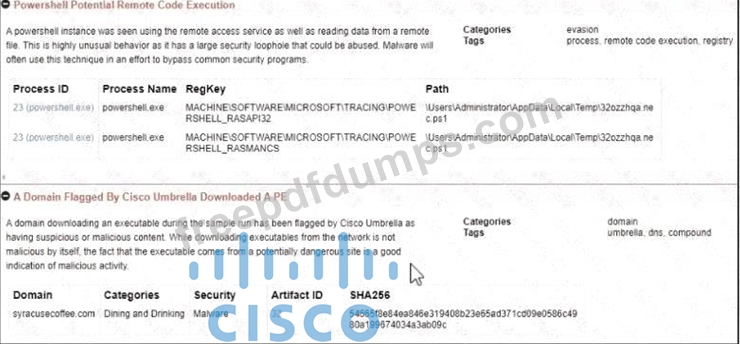
An engineer analyzes an email containing a malicious URL that was flagged by Cisco Secure Malware Analytics. The engineer checks the TCP streams and notices that a domain downloads an executable file during the sample run. Which action determines whether the email is malicious?
An engineer analyzes an email containing a malicious URL that was flagged by Cisco Secure Malware Analytics. The engineer checks the TCP streams and notices that a domain downloads an executable file during the sample run. Which action determines whether the email is malicious?